
7up7down by TaDa Gaming is a high-speed dice game that strips gambling down to its mathematical core. Using two six-sided dice, players bet on ranges or specific sums from 2 to 12. Set against a classic green casino felt, the game features a 30-second betting window and a 1000x Crit multiplier. With a maximum bet of $50 and a transparent history tracker, it offers a tactical experience for those who prefer probability over complex slot reels and bonus rounds.

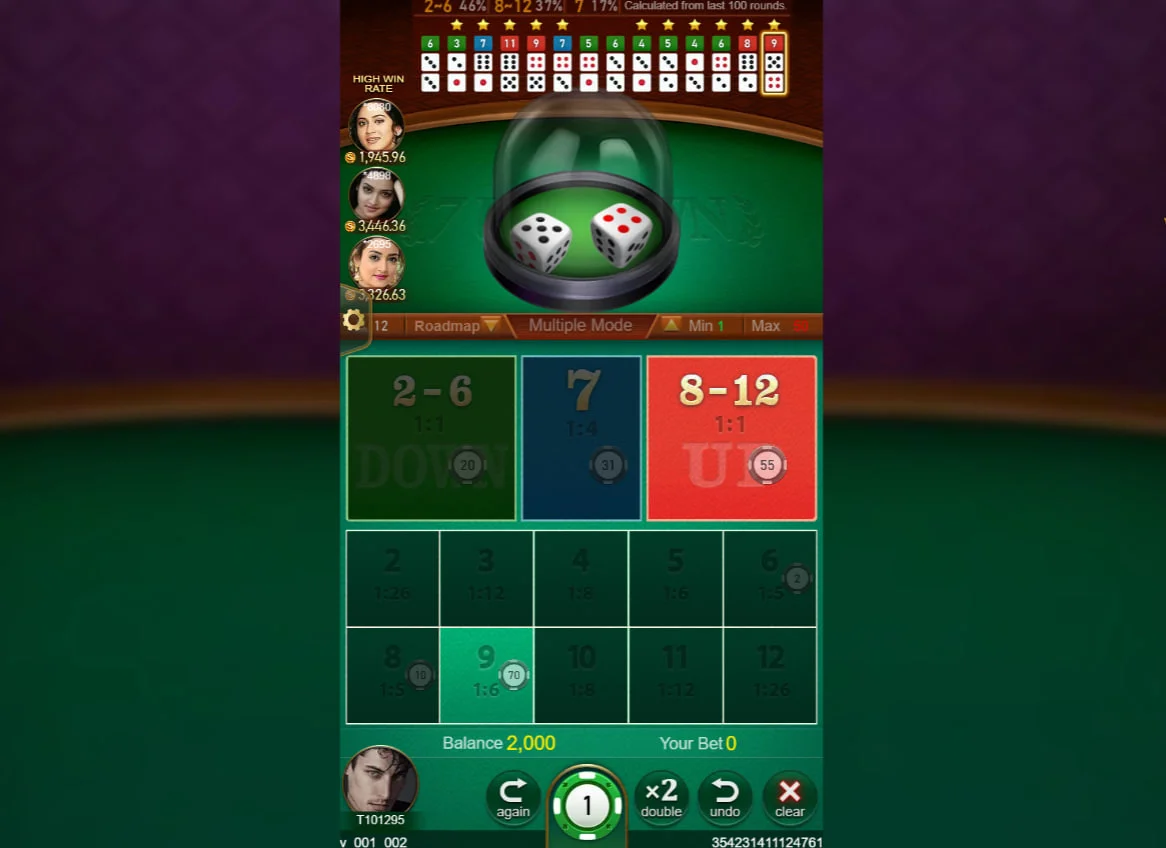
The core loop of 7up7down is refreshingly honest, operating on the fundamental mathematics of two dice. You are betting on the sum of the roll, which naturally ranges from 2 to 12. The interface is dominated by three primary zones: the 2-6 Down area, the lucky 7 center, and the 8-12 Up sector. Most of your session will likely be spent toggling between Down and Up, both of which offer a 1:1 payout. These are the bread-and-butter bets for players who prefer a lower friction environment, though the house edge is anchored by the 7, which sits as a blue island in the middle. Betting on the sum of 7 pays out at 1:4, reflecting its status as the most probable outcome in a standard dice distribution.
Beyond the basic ranges, TaDa Gaming provides a granular grid for those chasing higher multipliers. You can place stakes on specific sums like 2, 3, 4, 5, 6, 8, 9, 10, 11, and 12. The payouts here scale with the statistical rarity of the roll. For instance, hitting a sum of 2 or 12 is a 1 in 36 long shot, and the base payout of 1:37 reflects that risk. The middle-ground sums like 6 or 8 offer tighter rewards, keeping the balance afloat during longer sessions. The design is clean and functional, using a distinct color palette—green for Down, red for Up, and blue for 7—to ensure you never misplace a chip in the heat of a 30-second betting window.
The real game-changer is the Crit feature. After you’ve locked in your bets and the timer hits zero, the system has a random chance to trigger a Critical boost. This mechanic can catapult the maximum payout to a staggering 1000x your stake. It is a brilliant addition that adds a layer of “crash game” excitement to a traditional dice format. Watching the multiplier potential spike just before the dice settle creates a surge of adrenaline that most simple table games lack. For high-rollers, the $50 betting limit per item might seem restrictive, but the x2 button allows for rapid scaling of your total exposure across the grid.
From a grinder’s perspective, the multiplayer integration is a double-edged sword. You can see exactly where other players are putting their money, which is great for social validation but can lead to “tilt” if you see someone else hit a 1000x Crit on a number you just cleared. The UI is built for efficiency, featuring an “Again” button for instant rebets and a “Fresh Win Rate” history bar at the top. This history tracks the last 100 rounds, showing the percentage split between Down, 7, and Up. While it’s tempting to follow the “hot” or “cold” numbers, remember that the dice have no memory—each roll is a fresh calculation of 1 in 36 possibilities.
The Mechanics of Probability
Understanding the math behind 7up7down is the only way to survive the variance. Unlike slots with complex paylines and hidden RNG scripts, the logic here is transparent. There are 36 possible combinations with two dice, and the sum of 7 is the king of the hill with 6 ways to hit. The ranges 2-6 and 8-12 each cover 15 possible combinations. This means if you bet on Down, you have a 41.67% chance of winning, while the house takes the 7 and the opposite range.
The specific number bets are where the volatility spikes. Betting on a 2 or 12 is a high-risk play with a 2.78% hit frequency. If you are looking for a more consistent session, the 5, 6, 8, and 9 spots offer a better balance between payout and probability. The game rewards players who understand how to spread their risk across the grid, using the range bets as a hedge while hunting for a Crit trigger on the specific numbers.
Deep Dive into Technical Execution
TaDa Gaming built this for speed. The 30-second betting window is the perfect tempo—long enough to strategize, but short enough to keep the action moving. The “Undo” and “Clear” buttons are vital for cleaning up the board if you misclick while chasing a fast-moving trend. The game also features a robust disconnection protocol; if your internet drops after the bet is placed, the round completes on the server, ensuring you don’t lose a winning result to a technical glitch.
The visual feedback is sharp, with the dice shaking in a clear dome, removing any ambiguity about the result. It feels more “live” than a standard digital RNG game. For those who play on mobile, the layout is exceptionally ergonomic, with all betting zones easily reachable by thumb. The balance display and current bet total are always front and center, allowing for tight bankroll management during high-intensity streaks.
Unmasking the Dice Strategy
One of the biggest traps in 7up7down is the “Gambler’s Fallacy” fueled by the top history bar. Seeing a string of ten “Down” results might make you think “Up” is due, but the math doesn’t care about the past. The most effective way to play is to treat the range bets as your core position and use the specific number bets as “lottery tickets” for the Crit feature.
If you are looking for a low-volatility grind, sticking to the Down or Up ranges is the way to go. However, if you are here for the 1000x max win, you must be prepared for long stretches of “dead” rolls. The $50 cap per item means you can’t infinitely double up on a losing streak, which actually serves as a protective barrier for less disciplined players.
The Strategist’s Dossier
7up7down is a masterclass in distilled gambling. It removes the narrative weight of modern slots and replaces it with pure, mathematical tension. It is a game for players who want to see the gears turning and want a fair shot at a massive multiplier without navigating a dozen bonus sub-games.
- The Critical boost is a random event that can trigger on any bet type, not just specific numbers.
- The total combinations for a sum of 7 is 6, making it the most frequent outcome on the board.
- The betting timer is set to 30 seconds, forcing quick decisions and preventing analysis paralysis.
- Multiplayer mode allows you to click on player profiles to see their specific betting patterns in real-time.
- The game’s total maximum win is capped at 1000x, which is significantly higher than most traditional dice games.
- Range bets (2-6 and 8-12) provide the lowest variance, while specific numbers offer the highest potential rewards.
- A “Fresh Win Rate” indicator shows the percentage distribution of results over the last 100 rounds.
- The game operates under a “malfunction voids all pays” policy, a standard safeguard for digital table games.
FAQ
What is the maximum win possible in 7up7down?
The highest possible payout is 1000x your stake, achievable through the random Crit multiplier feature.
How does the Crit feature work?
Crit triggers randomly after bets are closed and before the dice roll, boosting potential payouts up to 1000X.
What are the betting limits for this game?
Players can place a maximum bet of $50 on any individual item or range on the board.
Where can I play the 7up7down demo?
You can access the 7up7down demo version for free on the Respinix.com website.
Which sum is most likely to appear in 7up7down?
The sum of 7 is statistically the most frequent result, which is why it has a specific 1:4 payout.