Zombie Blackjack by Genesis Gaming delivers a stylized version of the classic card game. The experience is framed within a gritty, post-apocalyptic setting, using horror and survival motifs for its visual presentation. This eight-deck Blackjack variant challenges players to achieve a hand total closer to 21 than the dealer’s without exceeding it. Standard actions like hitting, standing, doubling down (including after splits), and splitting pairs (with re-splitting Aces allowed) form the core gameplay. The game’s defining mechanic is the ‘Push on 22’ rule, where most active player hands result in a push if the dealer busts with exactly 22. While the dealer hits on soft 17, a natural player Blackjack still secures the premium 3:2 payout. This unique rule set offers a distinct challenge for Blackjack enthusiasts seeking a themed table game experience.
Genesis Gaming's Zombie Blackjack presents a familiar card game framework wrapped in a distinctly macabre aesthetic. While the core objective remains reaching 21 without exceeding it, this iteration introduces specific rule modifications, most notably the handling of a dealer bust on 22, which significantly alters the game's dynamics compared to traditional Blackjack structures
Thematic Presentation and Atmosphere
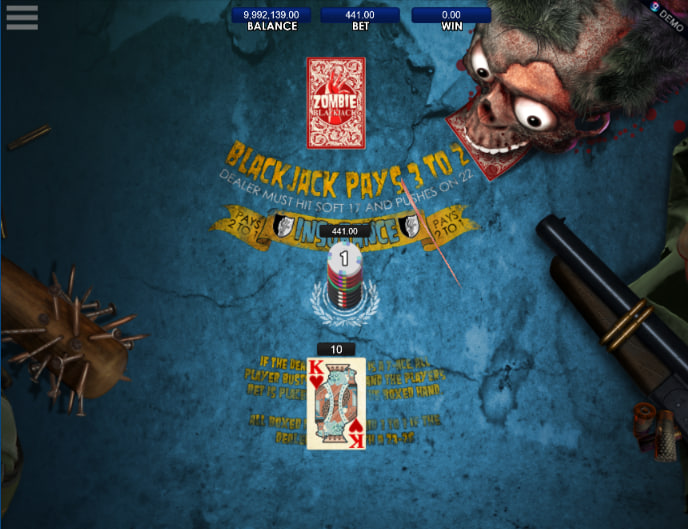
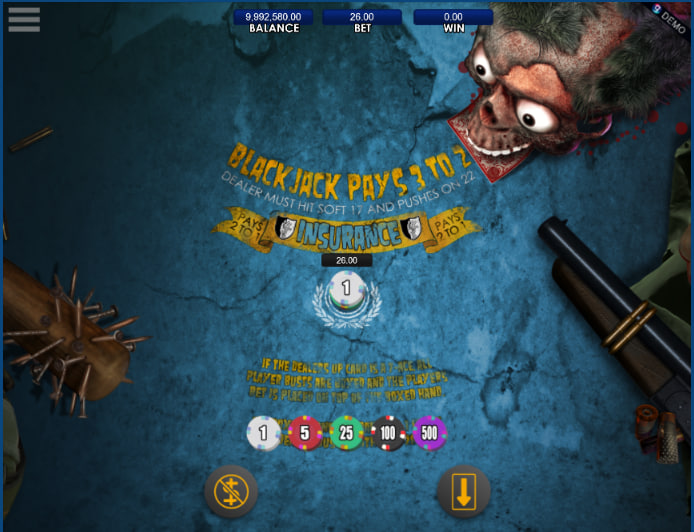
Zombie Blackjack leans heavily into its namesake theme, replacing the typical polished casino setting with a gritty, survivalist backdrop. The playing surface appears worn and stained, possibly resembling weathered metal or concrete, marked with crudely painted betting areas and rules summaries. Visual accents include a rather graphic zombie head leering from the corner, a bloody spiked baseball bat resting nearby, and a shotgun on the opposite side, firmly establishing the post-apocalyptic, undead motif. Even the playing cards feature a custom “Zombie Blackjack” logo, ensuring thematic consistency.
This visual overlay serves primarily as a stylistic choice. While striking, it does not fundamentally alter the card game's mathematical structure or decision-making process beyond the specific rule implementations detailed later. The atmosphere is one of grim novelty; whether this enhances or detracts from the playing experience depends entirely on individual preference for themed gaming environments versus straightforward, classic presentations. For players focused purely on optimal play and house edge, the visuals are secondary to the rule set.
Core Gameplay Mechanics
At its heart, Zombie Blackjack adheres to the standard objective of Blackjack: achieve a hand total closer to 21 than the dealer's without busting. The game utilizes eight standard 52-card decks, shuffled before the commencement of each round, dealt from a shoe. Card valuations are conventional: Aces count as 1 or 11, face cards (King, Queen, Jack) are valued at 10, and cards 2 through 9 retain their pip value.
The game offers the standard player actions:
Hit: Draw an additional card.
Stand: Decline further cards and finalize the hand total.
Double Down: Players can double their initial bet on any first two cards, receiving exactly one additional card afterward. Crucially, doubling down is also permitted after splitting pairs (DAS), a rule generally favorable to the player.
Split: If dealt a pair (two cards of identical rank) or any two 10-value cards (like a King and a Queen), the player can split them into two separate hands, placing an additional bet equal to the original wager on the second hand. Play then proceeds independently for each hand. Re-splitting Aces is allowed, although typically (and likely here, based on standard Blackjack conventions not explicitly contradicted) only one card is dealt to each split Ace, and achieving 21 on a split Ace counts as 21, not as a natural Blackjack. Players can generally hit multiple times on split pairs other than Aces.
One standard strategic option, Surrender, is explicitly disallowed in this variant, removing the player's ability to forfeit half their bet against a potentially strong dealer upcard.
The Undead Twist: Rule Variations and Implications
Beyond the core structure, Zombie Blackjack introduces several critical rule variations that define its unique character and directly impact game strategy and odds. Understanding these nuances is paramount for any experienced player.
The most impactful rule is how the game handles a dealer hand totaling 22. In standard Blackjack, any dealer total exceeding 21 constitutes a bust, resulting in a win for all remaining player hands. Here, however, if the dealer busts with exactly 22, all active player hands (those that have not busted) result in a push (tie). The player's bet is returned. The sole exception is a player Blackjack (an initial Ace and 10-value card), which still wins and is paid even against a dealer 22. This “Push on 22” rule significantly alters the game's mathematics, increasing the house advantage by turning potential player wins into pushes.
Another key rule is that the dealer must hit on a soft 17 (H17) – a hand totaling 17 that includes an Ace counted as 11 (e.g., Ace-6). This rule, compared to variants where the dealer stands on all 17s (S17), slightly increases the house edge as it gives the dealer an additional chance to improve their hand, albeit with a risk of busting. The game also employs the standard procedure where the dealer peeks for Blackjack if their upcard is an Ace or a 10-value card. If the dealer has Blackjack, the hand concludes immediately (unless the player also has Blackjack, resulting in a push). This prevents players from losing additional money on doubles or splits unnecessarily. Insurance is offered when the dealer shows an Ace, paying 2:1 if the dealer indeed has Blackjack, but remains a statistically unfavorable bet for the player in the long run.
The rules mention a peculiar scenario involving a “Coffin Bet” if the player busts and the dealer has a 7 through Ace showing, suggesting the busted wager is handled differently visually. The text then confusingly implies this “coffin bet” might be paid if the dealer subsequently busts with 23-26. This contradicts the fundamental Blackjack rule that a player bust results in an immediate loss. Given the ambiguity and conflict with standard practice, this phrasing might describe an internal game mechanic or visual marker rather than a payout on a lost bet. Players should operate under the standard assumption that a player bust loses the wager immediately, regardless of the dealer's final hand, unless explicitly and clearly demonstrated otherwise during gameplay. The clear rules are: dealer busts 23+ result in player wins; dealer bust on 22 is a push (except vs player BJ).
Betting Structure and Payouts
The betting range in Zombie Blackjack accommodates various bankrolls, with stated limits of a Minimum Bet of $1.00 and a Maximum Bet of $500.00 per hand.
Payouts adhere to some traditional standards while incorporating the effect of the Push 22 rule:
Standard Winning Hand: Pays 1:1 (even money). This applies when the player's hand total is higher than the dealer's total without exceeding 21, or when the dealer busts with a total of 23 or higher.
Player Blackjack: Pays 3:2. This premium payout for a natural is a crucial player-friendly aspect, particularly as it overcomes the dealer 22 push rule.
Insurance Bet: Pays 2:1 if the dealer has Blackjack.
Push: Occurs when the player and dealer have the same hand total, or, significantly, when the dealer busts with exactly 22 and the player has not busted and does not hold a Blackjack. In these scenarios, the player's bet is returned.
Strategic Considerations for Experienced Players
The specific rule combination in Zombie Blackjack necessitates adjustments to standard Blackjack basic strategy. The Dealer Hits Soft 17 (H17) rule inherently requires minor deviations from S17 strategy, generally involving slightly more aggressive hitting or doubling in certain situations.
However, the Push on 22 rule demands more significant strategic adaptation. Because a dealer 22 no longer results in a player win, the value of standing on marginal hands (like 12 through 16) against weak dealer upcards (like 4, 5, or 6) diminishes. The risk of the dealer drawing to 22 and turning a likely win into a push must be factored in. Conversely, the penalty for busting might be slightly less severe in situations where the alternative is standing and potentially facing a dealer 22 push. Players aiming for optimal play should consult strategy charts specifically designed for H17, Push 22 Blackjack variants. Standard basic strategy charts will not yield the best results.
The player-favorable rules – Double After Split (DAS), Double on Any Two Cards, and Re-Splitting Aces (RSA) – along with the 3:2 Blackjack payout, help mitigate the house edge increase imposed by the H17 and Push 22 rules. Nonetheless, the Push 22 condition generally has a substantial enough negative impact that the overall return-to-player (RTP) for this variant is likely lower than that of traditional Blackjack games featuring more standard rules (like S17 and dealer busts on all totals over 21 counting as player wins).
Verdict and Player Suitability
Zombie Blackjack by Genesis Gaming is a Blackjack variant that successfully integrates a strong visual theme with a distinct ruleset. Its appeal hinges on player priorities. The zombie aesthetic offers novelty, while the gameplay provides a specific Blackjack challenge defined by the Push on 22 and H17 rules.
Experienced players should approach this game with a clear understanding that its rules, particularly the dealer pushing on 22, result in a higher house advantage compared to many standard Blackjack offerings. While features like DAS, RSA, and doubling on any two cards are beneficial, they typically do not fully counteract the effect of the Push 22 rule. The retention of the 3:2 payout for Blackjack is a significant positive point.
This game is suitable for players who enjoy themed table games and are intrigued by alternative Blackjack rule sets, even if they come with slightly less favorable odds. Players whose primary goal is to find Blackjack games with the lowest possible house edge should likely look towards variants with more traditional rules (specifically S17 and standard dealer bust conditions). Zombie Blackjack offers a unique combination, but its defining rules require careful consideration and adjusted playing strategies.