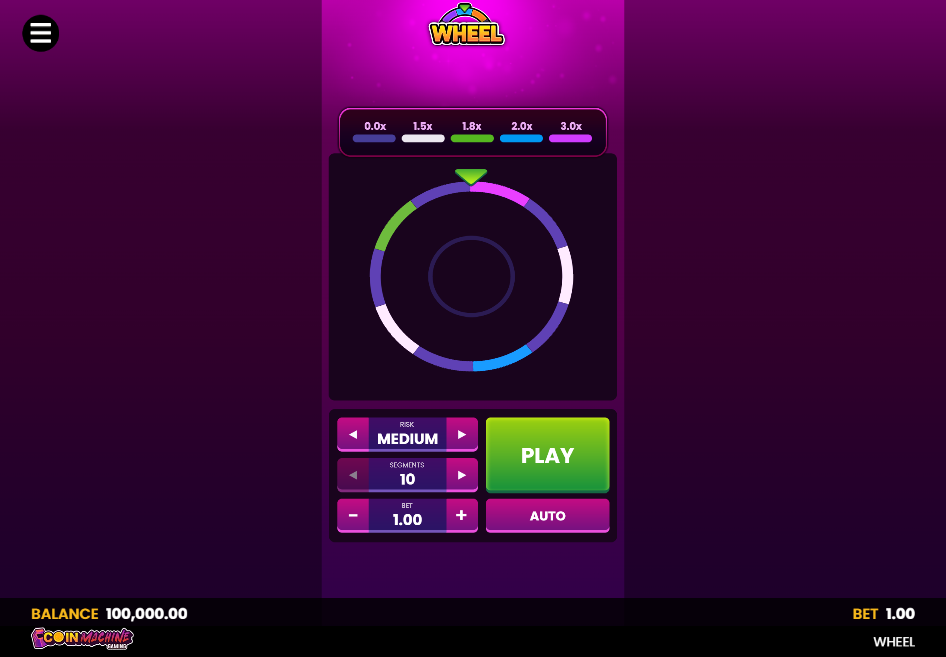
Forge your own odds with Wheel by Coin Machine Gaming. This minimalist arcade game lets you control the volatility by setting the risk and segments on a neon wheel.
 Wheel
Wheel
Key Gameplay Elements
| Feature Name | Description | Trigger / How it Works |
|---|---|---|
| Adjustable Risk Level | Players can select Low, Medium, or High risk before a spin. | Select the desired risk level using the arrows on the control panel. This directly alters the range and values of the multipliers on the wheel. |
| Adjustable Segments | Players can change the number of slices on the wheel, from 10 up to 50. | Use the arrows on the ‘Segments' control to increase or decrease the number of divisions on the wheel. More segments can mean more winning chances, but potentially lower value multipliers. |
| Multiplier Payouts | The game does not use traditional symbols. Each colored segment corresponds to a bet multiplier. | A winning outcome is achieved when the wheel's pointer lands on a segment with a multiplier value greater than 0.0x. The bet is then multiplied by that value. |
What Are the Core Controls in the Wheel Game Demo?
The core controls in the Wheel game demo are the Risk Level and Segment Selection toggles. These two settings work together to define the entire gameplay experience, allowing you to fundamentally alter the game's mathematical model before each spin.
The Risk Level Dial: Your Control Over Volatility
The most significant feature of the Wheel game is the ability to set your own volatility. This is done through a simple three-tier system: Low, Medium, and High risk. Unlike most online games where volatility is a fixed metric set by the developer, here it's a strategic choice you make.
- Low Risk: This setting is designed for a more consistent, albeit modest, gameplay experience. The multipliers will be lower, but the frequency of non-losing spins is generally higher. It’s an approach focused on extending playtime.
- Medium Risk: As the default setting, this offers a balanced mathematical profile. It provides a mix of smaller, frequent wins and the potential for more substantial multipliers.
- High Risk: Selecting this option changes the game's payout structure to favor higher potential rewards. The top-end multipliers increase significantly, but this comes at a cost—the number of ‘0.0x' or losing segments also increases. This is the setting for players chasing that single, game-changing spin.
This level of control is a core part of what makes the game interesting. It’s a mechanic that shares a philosophical link with the bonus rounds in some Hacksaw Gaming titles like Wanted Dead or a Wild, where the raw potential for high multipliers is the main draw.
Vlad Hvalov's Take:
“Honestly, the first thing I did in the Wheel demo was to just toggle the risk setting without even spinning. You can see the potential payouts shift right there at the top of the screen. It’s a transparent way of showing you the trade-off you’re about to make.”
Segment Selection: Crafting Your Own Wheel
Alongside the risk level, you can choose to divide the wheel into anywhere from 10 to 50 segments. This control has a direct impact on the probability of each outcome.
Choosing 10 segments creates a wheel with fewer, larger slices. This makes each outcome more impactful. When you combine this with a High-Risk setting, you get a very volatile game where a few segments hold massive potential value, and the rest are duds. It feels a bit like the high-stakes bonus game in Money Train 3.
Conversely, opting for 50 segments creates a wheel with many small slices. This spreads the probability out. It can make the game feel less punishing, as there are more potential stopping points for the pointer. However, it also means the value of each individual segment is diluted. The top prize might still be there, but it's now just one tiny slice among 49 others.
The Interplay: How Risk and Segments Create Your Strategy
The true depth of the Wheel game comes from how these two controls interact. A High-Risk, 10-segment setup is a completely different beast from a High-Risk, 50-segment one. The former is a game of jackpot-hunting, while the latter is a grind with occasional bursts of high value. Similarly, a Low-Risk, 50-segment game is about as low-volatility as you can get, designed for micro-wins to keep the balance ticking over. This custom-built mechanic feels like a simplified version of the risk-reward choices seen in some Crash Games available for free play across the web.
Is There a Winning Strategy for the Wheel Free Play Mode?
There is no single “winning” strategy for the Wheel free play mode, as the game is governed by a random number generator. However, you can adopt strategies that align with specific goals, such as maximizing playtime or chasing high multipliers, by manipulating the risk and segment controls.
Vlad Hvalov's Advice on Self-Control:
“The speed of this game is its biggest risk. My rule for the Wheel demo is simple: change your settings—either risk or segments—every 10 spins. It forces you to pause, break the hypnotic rhythm, and think about your strategy instead of just mindlessly clicking ‘Play'.”
A Look From the Other Side: Why “Higher Risk” Isn't the Holy Grail
There's a natural temptation to immediately crank the risk to High and hope for the best. And while this can lead to the most exciting payout—a 3.0x multiplier or higher—it's also the fastest way to drain your demo balance. The crucial thing to understand is that the ‘0.0x' segment is the house edge made visible. On a High-Risk setting, that segment grows in prominence. The game isn't hiding the fact that you're paying for the chance at a big win with an increased likelihood of losing spins. Honestly, the most consistent action I found was in the Medium setting with 20 or 30 segments.
Simulating Approaches: Low vs. High Volatility Setups
In the demo, you have a massive 100,000.00 balance, which is perfect for experimentation. Here are two approaches to test:
- The Marathon Runner: Set the risk to Low and the segments to 50. Place a small bet (e.g., 10.00). This setup is designed for longevity. You'll see frequent, small wins that keep your balance relatively stable. It's not the most exciting way to play, but it's an excellent way to understand how the base mechanics work.
- The Sprinter: Set the risk to High and the segments to 10. This is the all-or-nothing approach. Most of your spins will likely land on the 0.0x segment. However, the goal here is to experience the thrill of hitting one of the high-value multipliers. It’s a playstyle that mirrors the high-volatility chase in many Nolimit City games.
Beyond the Spin: Design and User Experience
The game belongs to the Technology and Sci-fi genres in its aesthetic, though its mechanics are pure Casino logic. The interface is clean and intuitive. Everything you need is on one screen, and the impact of your choices is reflected instantly on the wheel and the potential payout display. There are no complex menus or hidden rules.
The audiovisuals are minimalist. A simple electronic soundtrack accompanies the spins, and the neon colors pop against the dark background. It's a design that prioritizes function over form, ensuring nothing distracts from the core mechanical choices you have to make. It’s a design philosophy that focuses on the purity of the chance, a bit like the classic feel you get from some Retro slots.
Vlad Hvalov's Expert Tip:
“Don't just watch the pointer. Watch the multiplier values at the top of the screen as you change the risk level. That's the real game. It tells you exactly what prize you're playing for before you even commit to a spin.”
Wheel Compared to Other Instant Win Games
The Wheel game fits into a growing category of simple, fast-paced online games that move away from the traditional 5×3 slot format.
- Compared to Plinko of Mine by TaDa Gaming, Wheel offers more direct control. In Plinko, you choose the risk level, but the path of the ball is random. In Wheel, your choice of segments feels like a more deterministic way of setting up the board.
- Against games like Big Bass Crash from Pragmatic Play, the pressure is different. Crash games are a game of nerve—cashing out before the crash. Wheel is a game of setup—making the right strategic choices before the spin.
- Even when compared to other Wheel of Fortune slots, this game stands out. Most use the wheel as a secondary bonus feature, like in Wheel O'Gold. Here, the wheel is the entire game, and its configuration is in your hands. Other games you might enjoy if you like this style of direct, mechanic-focused gameplay include the raw volatility of Chaos Crew 2 or the simple multiplier fun of Aviameisters Demo.
For those looking for a different kind of simple, multiplier-focused game, Gem Trio offers a more classic slot feel but with a strong emphasis on gem multipliers. And if you want to see how far the concept of non-traditional reels can go, Ancient Tumble provides a complex and engaging alternative.
The Streamer's Spin Cycle
How does Wheel stack up for a streaming audience on Twitch or YouTube? Here's the verdict.
- Visual Appeal: High. The clean, neon design is easy on the eyes and translates well to a screen. The spinning wheel is a universally understood and visually engaging mechanic. There’s no clutter, so big wins are easy to spot and celebrate.
- “Big Win” Potential: Excellent. This game is made for creating highlight clips. A streamer setting the risk to High, betting big, and hitting the top multiplier is peak content. The build-up of tension during the spin is palpable and makes for great reactions.
- Dynamics: This is the weak point. The gameplay loop is very fast and can become repetitive. A stream of just spinning the wheel could get boring without an engaging personality to drive the narrative. It’s not a game that tells its own story like Rich Wilde and the Tome of Madness.
The final verdict for streamers is that Wheel is a fantastic secondary game. It's perfect for a high-energy session, a bonus buy style challenge, or as a way to interact with the chat by letting them choose the risk and segment settings. It is a hype-generator, not a long-form adventure.
The Wheel's Spectrum: More Than Just Color
Since there are no traditional symbols, the colored segments themselves become the icons of chance. Each color on the wheel carries its own weight and meaning within the game's simple ecosystem.
| Segment Color | Its Role in the Game |
|---|---|
| Magenta (e.g., 3.0x) | The Apex. This color represents the pinnacle of risk and reward. Landing on it is a rare event that defines a successful high-risk session. |
| Cyan (e.g., 2.0x) | The Stabilizer. A cool, rewarding color. It represents a significant win that can substantially boost the balance without the extreme odds of the Apex. |
| Green (e.g., 1.5x) | The Workhorse. This is the color of consistent, positive returns. It keeps the game moving and funds the continued hunt for bigger multipliers. |
| Purple (e.g., 0.0x) | The Void. This is the most common color, especially on higher risk settings. It represents the cost of entry for each spin, the reset that makes the wins meaningful. |
My Final Take on Coin Machine Gaming's Wheel
So, what's the final word on the Wheel demo? It's a game of refreshing honesty. It strips the slot experience down to its mathematical core and invites you to play with the numbers. I have to say, it's not for everyone. If you come to online games for escapism, for stories, for characters… you won't find them here. Look towards titles like Book of Dead or the cinematic The Goonies for that.
However, if you're a player who is fascinated by the mechanics of chance, who likes to feel in control, and who wants to test out risk-reward strategies, then the Wheel free play mode is an excellent sandbox. Coin Machine Gaming has created a sharp, focused tool that respects the player's intelligence. It’s a game that asks a question: “How lucky do you feel?” and then gives you the power to define what “lucky” even means. I recommend giving it a try, not as a replacement for your favorite themed slot, but as a different kind of analytical exercise. It's a surprisingly engaging experience.
FAQ
How does the ‘Risk' setting work in the Wheel game?
The ‘Risk' setting (Low, Medium, or High) directly adjusts the game's volatility by changing the range of multiplier values on the wheel segments.
Is it better to choose more or fewer segments on the wheel?
It depends on your strategy; fewer segments (e.g., 10) lead to higher volatility with bigger swings, while more segments (e.g., 50) create a lower volatility experience with more frequent, smaller wins.
What is the maximum potential win in the Wheel slot?
The maximum win is determined by the highest multiplier available, which increases when you select the ‘High Risk' setting; in the base view, it is 3.0x the bet.
Where can I play the Wheel game demo for free?
The Wheel demo version is available for free play directly on the Respinix.com website.
Who is the developer behind the Wheel game?
The Wheel game was created by the provider Coin Machine Gaming.
Is the Wheel game a traditional slot machine?
No, it is not a traditional slot; it is an arcade-style wheel of fortune game with a focus on player-controlled settings rather than reels and paylines.
Does the Wheel game have a free spins bonus round?
No, the Wheel game does not include a free spins feature or any traditional bonus rounds; its core features are the adjustable risk and segment mechanics.
What kind of player would enjoy the Wheel game?
Players who enjoy strategy, probability, and having direct control over a game's volatility will find Wheel particularly engaging.