Gamanza’s Pinata game moves away from traditional reels, offering a direct burst mechanic experience. The game’s festive piñata theme is set against a serene, pastel-colored sky, creating a lighthearted atmosphere. Its core gameplay consists of striking the piñata to receive an instant prize multiplier. The layout has no reels or paylines, focusing entirely on this singular action and its outcome. The base game functions with high volatility, presenting the chance for a 1000x multiplier from one hit. This contrasts with the main bonus feature, a round of free hits where winnings are the cumulative total of smaller, more frequent multipliers. This dual-payout design operates with a variable RTP of 93.26% to 96.72%. The gameplay provides a straightforward session based on direct probability and distinct reward structures.
Gamanza Games presents “Pinata,” a title that sidesteps the conventional reel and payline structure common to most free online slots. Instead of symbols aligning on a grid, the entire experience is focused on a single, repetitive action: striking a colorful pinata suspended against a dreamlike sky. This design choice places it firmly in the category of burst mechanic or instant win games, offering a fundamentally different rhythm and set of expectations for the player. The game's appeal hinges not on intricate symbol combinations but on the raw probability of each strike yielding a reward. What sets it apart further is its dual-payout system, with markedly different reward structures between the base gameplay and its central bonus feature. This review will dissect the mechanics, mathematical models, and atmospheric choices that define the Pinata experience.
Bonus Features and Payout Structure
The core deviation from the base game is the Bonus Game. Based on the game's documentation, this feature appears to activate as a random outcome following any given hit in the main game. Upon activation, the player is awarded a set number of “free hits.” While the documentation mentions a “Golden Bat” and “10 hits,” the primary function is a shift in the payout mechanics. Instead of a single large potential outcome, the bonus round is designed around accumulating smaller rewards over a series of strikes. The total prize for the bonus is the cumulative sum of the multipliers won from each individual hit within the round.
This cumulative approach creates a distinct form of anticipation. A single hit in the bonus round might award a low 0.4x multiplier or even a 0x, but the overall potential builds with each successive strike. This contrasts sharply with the all-or-nothing nature of a single spin in a traditional slot. The potential payout multipliers for each hit during this bonus phase are as follows: 0.4x, 0.7x, 1x, 1.2x, 1.4x, 1.7x, 2x, 3x, 5x, 7.5x, and 10x. For instance, a 10-hit round might see outcomes like 1x, 0x, 3x, 0.4x, 5x, 0x, 1.7x, 1.2x, 0.7x, and 7.5x. The final payout would be the sum of these values (1 + 0 + 3 + 0.4 + 5 + 0 + 1.7 + 1.2 + 0.7 + 7.5), resulting in a total multiplier of 20.5x applied to the stake that initiated the feature. This methodical accumulation of value may appeal to players who prefer a more granular and extended reward sequence.
Further amplifying this feature is the prominent Bonus Buy option. Gamanza offers players a direct path to the bonus round for a fixed price relative to their chosen stake. The options are quite specific and present an interesting decision for the player:
10 free hits: Costs 9.38x the base stake.
15 free hits: Costs 14.07x the base stake.
25 free hits: Costs 23.44x the base stake.
Randomly assigned free hits: Costs 15.63x the base stake.
The final option is particularly noteworthy. For a cost slightly higher than the 15-hit option, the player receives a random number of hits, which could be 10, 15, or 25. This introduces a layer of volatility before the bonus round even begins. A player is essentially betting that the random assignment will land on 25 hits, securing the most potential at a significant discount compared to its direct purchase price. This pricing structure is a calculated risk-reward proposition aimed squarely at the experienced player familiar with bonus buy mechanics and their inherent trade-offs.
Core Gameplay and Base Game Mechanics
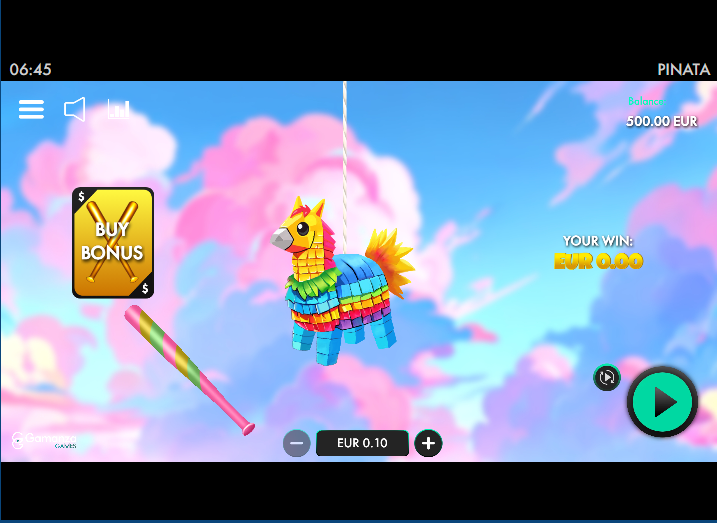
The primary gameplay loop of Pinata is defined by its simplicity. The player interface is minimalist, with controls to adjust the bet amount and a large play button. Each press of the play button initiates a single game round, which consists of a bat striking the pinata. The outcome is immediate: either a prize multiplier is awarded, or the hit yields no return. This instant feedback loop is the game's defining characteristic, removing the suspense of waiting for reels to settle and focusing entirely on the binary result of the hit.
The payout potential in the main game follows a much more top-heavy model compared to the bonus round. A single successful strike can award a multiplier from a wide-ranging paytable. The possible multipliers are 1x, 2x, 2.5x, 3.5x, 5x, 10x, 20x, 50x, 100x, 200x, 500x, and a maximum of 1000x the stake. This structure creates a high-volatility environment where most hits may result in small or no wins, punctuated by the rare possibility of a very large payout from a single action. The game's description alludes to this 1000x prize as the reward for “completely breaking” the pinata, tying the game's ultimate mechanical goal to its thematic premise.
This stark difference in payout philosophy between the base and bonus games is a central element of the design. The base game is a lottery-style hunt for a single, game-changing hit. The bonus game, conversely, is a marathon of accumulating smaller, more frequent wins. This design choice caters to different player psychologies. Those who prefer the thrill of chasing a massive, singular jackpot might find the base game more compelling, while those who enjoy seeing a balance build steadily, even from small increments, will likely find more satisfaction in the bonus feature's cumulative structure.
Visual Presentation and Atmosphere
Visually, Pinata presents a curious juxtaposition. The background is a soft-focus, almost ethereal canvas of pastel pink, purple, and blue clouds. The aesthetic is serene and calming, reminiscent of a pleasant daydream. Floating in the center of this tranquil scene is the titular pinata, a brightly colored horse rendered in a blocky, papercraft style. Its segmented, corrugated paper texture is well-realized, giving it a tangible, fragile quality. This peaceful setting is periodically interrupted by the swift, clean swing of a rainbow-gradient bat, the instrument of the game's core action.
The animation is functional and direct, reinforcing the game's simple mechanics. When the play button is pressed, the bat executes a smooth arc and makes contact with the pinata. The pinata jiggles and might shed a few small, colored squares of paper, a subtle visual cue that a “hit” has registered. When a prize is awarded, the multiplier value appears clearly on the screen. There are no elaborate cinematic sequences or distracting character animations. This minimalism keeps the focus entirely on the outcome of the strike.
For players who find such animations repetitive, the game includes a Fast Mode setting. This quality-of-life feature reduces animation time, allowing for a much more rapid succession of game rounds. This is a practical addition for players focused purely on the mathematical outcomes or those who wish to play a high volume of rounds in a short period. The overall presentation is clean and polished, but its primary function is to serve the directness of the gameplay rather than to create a deep, narrative-driven world. The mood is one of light, festive fun, but the mechanics underneath are a serious exercise in probability and instant rewards.
A Deeper Look at the Game's Design Philosophy
Gamanza provides a variable Return to Player (RTP) for Pinata, stated as being between 93.26% and 96.72%. A variable RTP often indicates that the figure can differ based on casino operator settings or, more commonly, on player choices within the game. In this case, the RTP is likely influenced by the use of the Bonus Buy feature. Different purchase options can carry their own specific mathematical models, resulting in a different theoretical return compared to playing the base game exclusively. This range is an important piece of information for the analytical player, who understands that how they choose to interact with the game can impact its long-term performance metrics.

The game's design is an intentional departure from complexity. It will likely resonate with players who feel modern video slots have become overburdened with convoluted features, multiple meters to fill, and complex narrative arcs. Pinata strips the experience down to its most basic components: a wager and an immediate, singular outcome. This can be seen as either a strength or a weakness. For those seeking depth and a developing gameplay state, the repetitive nature of hitting the same object might feel monotonous. However, for players looking for a quick, straightforward session of chance without the need to learn intricate rules, this game offers an accessible and direct form of entertainment. It serves a specific niche of the online gaming audience very effectively.
The mathematical distinction between the base game’s single payout and the bonus game's additive total is a key concept. If the mechanics of how bonus round payouts are summed up are not immediately clear from the descriptions, launching the demo Pinata version and accessing the in-game help menu (usually marked with an ‘i' icon) provides a comprehensive official breakdown from the developer. This can be particularly useful for understanding the risk-reward calculation of the various Bonus Buy options before committing to a particular strategy. This game is less about the journey and entirely about the destination of each individual click. This focus makes it a rather pure distillation of the core gambling proposition, presented in a bright and cheerful package.