
iMoon’s Limbo presents an analytical approach to the instant win format, using a clean cosmic theme as its backdrop. The game’s atmosphere is intentionally minimalist and fast-paced, focusing the player’s attention squarely on its central mechanic. It forgoes a traditional reel-and-payline layout entirely, building its core gameplay around player prediction. Before each round, the player must set a specific target payout multiplier. The game’s primary feature is this direct relationship, as choosing a higher multiplier inherently lowers the displayed probability of winning. This design effectively puts control of the round’s volatility directly into the player’s hands. There are no conventional bonus rounds or free spins; the strategic depth comes from assessing the risk of the target you set. This rapid, function-first design provides a distinct experience for players who favor direct statistical challenges.

iMoon’s Limbo presents a departure from the conventional reel-spinning format commonly associated with online casino games. It operates within the increasingly popular category of multiplier-based crash games, yet it distinguishes itself through a fundamental alteration of the core player interaction. Instead of tasking the player with deciding when to exit a climbing multiplier, Limbo bases its entire premise on a pre-round prediction. The player sets a target multiplier, and the outcome is determined instantly. This design choice shifts the game’s dynamic from one of real-time reaction and nerve to one of statistical assessment and calculated risk-setting. The game presents itself not as a narrative-driven spectacle, but as a direct, fast-paced mechanism for testing one's appetite for risk against a random number generator. Its minimalist presentation, featuring a simple cosmic backdrop, reinforces this focus on pure mechanics over thematic immersion, making it a subject of interest for players who prioritize strategic decision-making and rapid gameplay cycles.
The Central Gameplay Dynamic: Risk and Reward
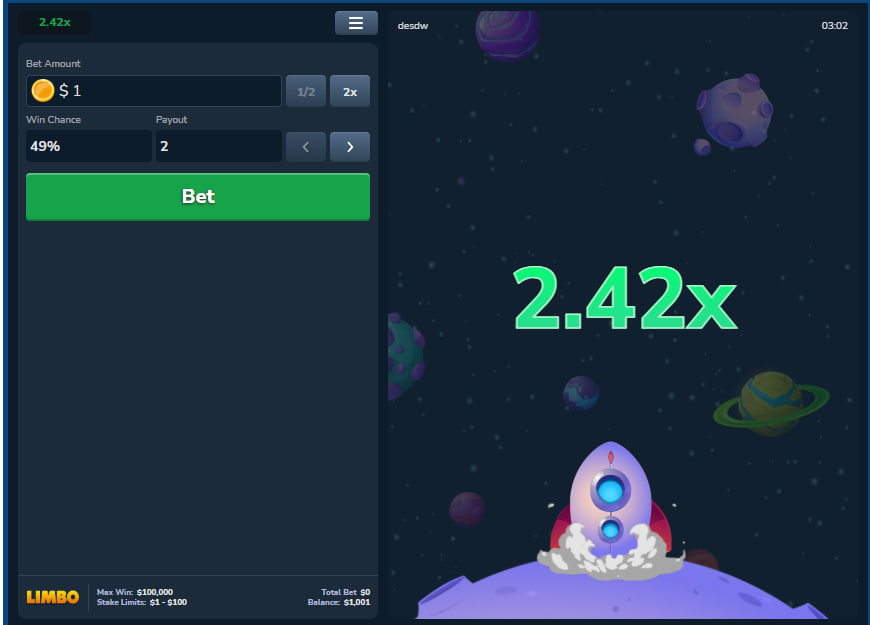
The primary interaction in Limbo is remarkably straightforward, yet it contains the game's entire strategic depth. The process involves two key decisions made by the player before initiating a round: setting the Bet Amount and, more critically, defining the Target Payout. This target is the multiplier the player predicts the game's randomly generated outcome will meet or exceed. Once the “Bet” button is engaged, the game instantly produces a result, and the round concludes. A win occurs if the generated multiplier is equal to or greater than the player’s chosen target; otherwise, the bet is lost. There are no intermediate steps, no cascading features, and no secondary bonus screens.
The defining characteristic of this system is the direct and transparent inverse relationship between the selected Target Payout and the displayed Win Chance. This is the core of the game's design. For example, selecting a low, conservative target like 1.50x might display a relatively high Win Chance, such as 66%. Conversely, setting an ambitious target of 10x will cause the Win Chance percentage to drop dramatically, perhaps to less than 10%. The game's interface updates this percentage in real-time as the player adjusts the target multiplier, providing immediate feedback on the statistical probability associated with their choice. This function serves as the central pillar of player strategy, turning each round into a conscious decision about risk tolerance. The player is not just placing a bet; they are actively calibrating the difficulty and potential reward for that specific wager.
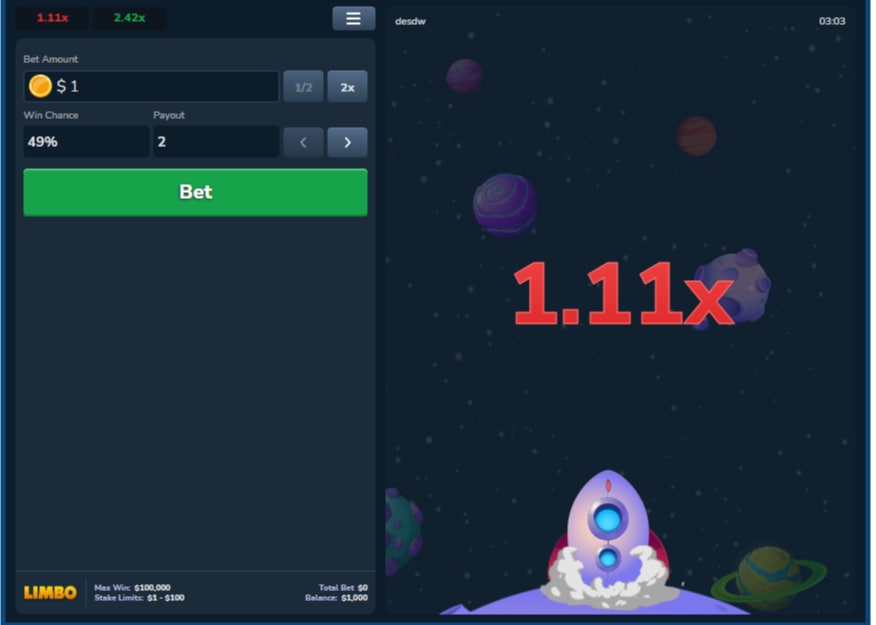
This mechanic essentially allows players to customize the volatility of each round. A player seeking frequent, smaller returns can consistently set low multipliers, while a player aiming for a significant payout on a single round must accept the correspondingly low probability of success. The interface's history log, which displays the results of previous rounds, adds another layer for analytical players. While past results do not influence future outcomes in a truly random system, observing the frequency of certain multiplier ranges can inform a player's short-term strategy and risk assessment. The game, therefore, becomes a continuous exercise in probability assessment, managed entirely through the simple adjustment of the target multiplier.
Analysis of the Bonus Structure and Features
Limbo intentionally eschews what are traditionally considered bonus features in online slots. There are no free spins, wild symbols, scatter-triggered events, or multi-level bonus games. The “feature” of the game is its core mechanic itself—the ability for the player to dictate the terms of their potential win. This can be viewed as a significant point of differentiation. Whereas traditional slots gate their highest potential payouts behind randomly triggered, often complex bonus rounds, Limbo makes its full payout potential available on any given round, provided the player is willing to set a high enough target multiplier and accept the associated low win probability.
The game's design entirely bypasses the element of surprise triggering. The player is in full control of initiating every high-potential round. For instance, the maximum win of $100,000 is not tied to a specific combination of rare symbols but is theoretically achievable by setting a sufficiently large multiplier target with a corresponding wager. The mechanism is direct: your potential for a massive payout is not hidden behind layers of RNG, but is a direct function of the risk you choose to take upfront. The absence of traditional bonuses means the gameplay loop is exceptionally fast and uninterrupted. There are no transitions to different screens or lengthy animations that pause the action.
This approach will appeal to a specific player profile: one who finds traditional bonus features to be an unnecessary delay and prefers a more direct and quantifiable relationship between risk and reward. The game does not build anticipation through accumulating symbols; instead, the tension is entirely self-imposed by the player before the round even begins. The mathematical relationship between the target multiplier and win chance is a critical component to grasp for any serious play. If the precise formula or its implications are not immediately clear from the interface, it can be beneficial to run the Limbo demo and open the built-in help file, often accessed by clicking an information icon (i), which provides the developer’s detailed official explanation of the game's rules and payout structure.
Atmosphere, Animation, and Artistic Direction
The visual and auditory presentation of Limbo is best described as functional minimalism. The provider, iMoon, has opted for a clean, uncluttered interface that prioritizes information delivery over sensory spectacle. The backdrop is a static, stylized depiction of outer space, with cartoonish planets and asteroids drifting gently. At the bottom of the screen sits a small rocket, which serves as the game's only active animated element. Upon placing a bet, the rocket shudders briefly as if launching, and the resulting multiplier appears in large, bold numbers in the center of the screen. The animation is swift and unobtrusive, designed to communicate the result without delaying the start of the next round.
This restrained artistic direction is a deliberate choice that complements the game's mechanical focus. There are no elaborate win animations or celebratory soundscapes for large payouts. A win is communicated with the same efficiency as a loss. This creates a detached, analytical atmosphere. The color palette is dominated by dark blues and purples, which is easy on the eyes for extended sessions, and the key interface elements—the bet controls and the result—are rendered in bright, contrasting colors for maximum legibility. The sound design follows suit, with subtle clicks for interface interactions and a simple, non-distracting sound effect to announce the round's completion.
The overall effect is that the game's theme is secondary to its function. The space motif serves as a pleasant, neutral canvas rather than a narrative framework. The rocket does not go on a journey; it is merely a visual metaphor for the “launch” of a bet. This design philosophy stands in stark contrast to many modern slots that invest heavily in cinematic cutscenes and character development. iMoon's approach in Limbo suggests a confidence in the strength of its core gameplay loop, believing it to be compelling enough without the need for ornamental distractions. It caters to players who value clarity and speed above all else.
A Comparative Perspective within Instant Games
To fully appreciate Limbo's design, it is useful to place it in context with other games in the “crash” genre. The archetypal crash game involves a multiplier that starts at 1.00x and increases steadily over time, while players who have placed a bet must choose to “cash out” before the multiplier randomly “crashes.” The core tension in those games is a test of nerve and timing: cash out too early, and you miss out on a higher potential win; wait too long, and you lose everything.
Limbo fundamentally alters this dynamic by moving the critical decision point from during the round to before it. In Limbo, there is no climbing multiplier to watch and no manual cash-out button to press under pressure. The player's agency is exercised entirely in the setup phase. This creates a different psychological experience. It replaces the anxiety of real-time decision-making with the intellectual challenge of pre-round probability assessment. A player in a standard crash game might feel regret for cashing out at 5x when the multiplier reached 50x. A Limbo player's potential regret is different; it is tied to whether they set their initial target too high or too low for the outcome that occurred.
This structural difference makes Limbo a much faster-paced game. Rounds are resolved instantly, allowing for a significantly higher number of wagers in a given period compared to a crash game that might take several seconds for its multiplier to develop. Limbo is a game of discreet, independent trials, whereas a traditional crash game is a single, shared, continuous event for all participants in that round. By removing the shared social element and the in-round drama, iMoon has distilled the experience down to its mathematical essence: a direct wager against a random number generator where the player sets the terms of engagement. This makes it a less frantic, more methodical alternative within the broader category of instant-win multiplier games.