Caleta Gaming’s Hi-Loaf presents a focused game of chance, stripping away reels and paylines for a singular, high-stakes proposition. The game features a lighthearted breakfast toast theme, creating a casual atmosphere that belies its tense core mechanic. Players engage in a direct 50/50 prediction, guessing the outcome of a flipped piece of toast to advance. This design results in extremely volatile gameplay, where each round is an all-or-nothing event. The primary feature is a progressive Multiplier Ladder Gamble; each correct guess allows the player to either collect their winnings or risk them for a greater reward. With a stated RTP of 93.7%, the structure is built for decisive moments rather than sustained play. Successive correct predictions move the player up a 10-step ladder towards the maximum potential win of x959 the initial stake. This title is engineered for players who appreciate the purity of a binary gamble and direct risk management.

 Hi-Loaf
Caleta Gaming’s Hi-Loaf presents a deliberate deviation from the feature-laden video slots that dominate the current market. This title strips the gameplay experience down to its most fundamental element: a game of pure chance. It is not a slot machine in any conventional sense; there are no reels, paylines, or symbol combinations. Instead, it offers a sequential risk-and-reward structure built around a single, recurring 50/50 proposition. The choice of a breakfast toast theme is an interesting one, providing a lighthearted visual wrapper for a surprisingly tense core mechanic. For seasoned players looking for a transparent and straightforward test of nerve, Hi-Loaf offers a very different form of engagement.
The game is constructed around a progression system where success hinges entirely on correctly predicting a binary outcome. It bypasses the complexity of modern slot features in favor of a clear, albeit unforgiving, path to potentially substantial multipliers. This design choice by Caleta Gaming positions Hi-Loaf as a title for a specific player mindset, one that values the purity of the gamble over thematic immersion or intricate bonus rounds. Its success is not measured in its graphical complexity but in the effectiveness of its core loop.
Unpacking the Central Mechanic and Payout Structure
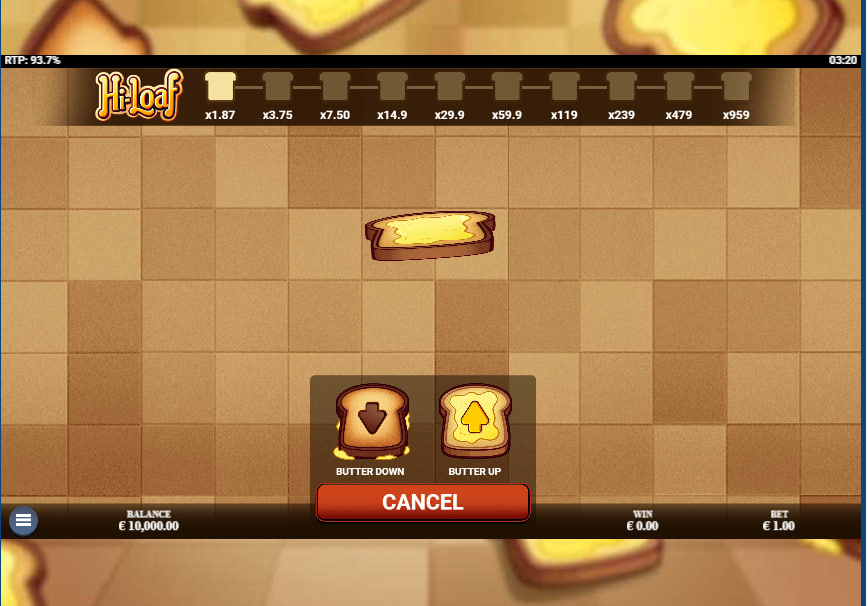
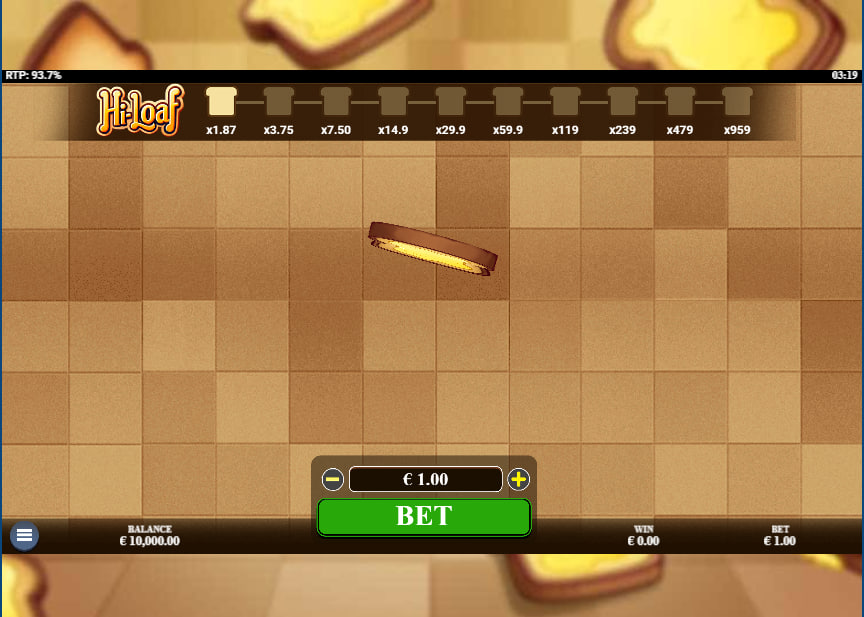
The entire gameplay of Hi-Loaf is contained within a single, repeating sequence. A round begins after a wager is placed. At this point, a slice of buttered toast appears, and the player is presented with two options: “Butter Up” or “Butter Down”. The objective is to guess the orientation in which the toast will land after being tossed. This is the central, unalterable action of the game. There is no skill, pattern recognition, or external factor that can influence this outcome; it functions as a digital coin flip. An incorrect guess results in the immediate forfeiture of the initial stake for that round, and the game concludes, requiring a new bet to start over.
Upon a correct guess, the player advances one step up a multiplier ladder, prominently displayed at the top of the screen. The round does not end. Instead, the player faces a critical decision: either Collect the current winnings or continue playing by making another “Butter Up” or “Butter Down” prediction. This choice represents the entire strategic depth of Hi-Loaf. Opting to collect secures the prize associated with the current step, which is the multiplier value times the initial bet, and ends the round. Choosing to continue means risking the entire accumulated winnings for the chance to advance to the next, more valuable multiplier. This tension between securing a smaller, guaranteed win and risking it for a larger potential payout is the game's primary source of engagement.
The multiplier progression is fixed and clearly displayed for the initial stages. The ladder begins as follows:
1st Correct Guess: x1.87 multiplier
2nd Correct Guess: x3.75 multiplier
3rd Correct Guess: x7.50 multiplier
4th Correct Guess: x14.9 multiplier
5th Correct Guess: x29.9 multiplier
A notable aspect of the design is that the complete progression bar is not shown from the start. After five consecutive correct guesses are achieved, the subsequent steps on the ladder are revealed one by one with each successful outcome. This continues for a total of 10 steps, culminating in the maximum prize of x959 the initial bet. Achieving this top prize requires ten consecutive correct predictions. Upon reaching the tenth step, the maximum prize is awarded automatically, and the round concludes. The precise functionality and payout structure for the later stages can be observed directly within the game's official rules. If there is any confusion about how the higher-tier multipliers are unveiled, a practical way to clarify this is to launch the Hi-Loaf demo version and consult the official in-game help file, typically accessed by pressing the ‘(i)' icon.
Aesthetic Execution and Thematic Atmosphere
Visually, Hi-Loaf is defined by its simplicity. The art style is a clean, 2D cartoon aesthetic that is functional and unobtrusive. The background is a repeating pattern of light and dark brown tiles, evoking a kitchen countertop or checkerboard, which keeps the focus squarely on the gameplay elements. The central animation—the flipping toast—is smooth but brief. It serves its purpose without any elaborate visual flair. The game's primary symbols are the toast itself, rendered with a friendly, almost comforting appearance, and the two choice buttons. The design is intentional in its minimalism; it avoids any visual distractions that might detract from the core decision-making process.
The sound design complements the simple visuals. There are understated auditory cues for placing a bet, making a choice, and revealing the outcome. A correct guess is met with a positive, encouraging sound effect, while an incorrect guess triggers a more muted, final-sounding tone. These sounds are functional, providing clear feedback without becoming repetitive or annoying over extended sessions. The animation of the toast landing butter-side up or down is the main visual event of each turn. The “splat” effect when it lands is a small but satisfying piece of animation that punctuates the moment of reveal.
The overall atmosphere created by this combination of simple graphics and a lighthearted theme is one of casual amusement, which stands in stark contrast to the high-stakes nature of the gameplay. The mundane subject of buttered toast serves to lower the initial perceived intensity, making the game approachable. However, as a player advances up the multiplier ladder, the psychological tension rises significantly. This juxtaposition is perhaps the most interesting aspect of the game's design. It wraps a tense, all-or-nothing gamble mechanic in a disarmingly charming package, creating a somewhat unusual player experience.
The mathematical foundation of Hi-Loaf is transparent. With an officially stated Return to Player (RTP) of 93.7%, the game positions itself on the lower end of the spectrum compared to the industry average for online slots, which typically hovers around 96%. For an experienced player, this lower RTP is a direct reflection of the game's binary, high-risk structure. In a standard slot, smaller, frequent wins contribute to the overall RTP. Here, every turn is an all-or-nothing event. The house edge is realized through the 50/50 probability over a large number of rounds.
The volatility of Hi-Loaf is, by its very nature, extreme. There is no concept of low, medium, or high volatility in the traditional slot sense. Instead, each round results in one of two outcomes: a complete loss of the stake or a win of at least x1.87. This creates a highly polarized experience. Players will not find any small, sustaining payouts to keep their balance stable. A session will consist of a series of lost stakes punctuated by moments where the player must decide how far to press a winning streak. This structure is fundamentally different from games with cascading reels or frequent small wins, which are designed to extend playtime. Hi-Loaf is designed for decisive, impactful rounds.
The game's structure can be compared to other instant-win or “Crash” style games, but with a key difference. While many Crash games feature a continuously rising multiplier that a player can cash out at any moment, Hi-Loaf presents a series of discrete, locked-in steps. You cannot collect a prize that is halfway between x3.75 and x7.50. You must successfully clear the hurdle to x7.50 before that multiplier becomes available. This step-based progression makes each decision point more pronounced and psychologically weighty. The jump in multipliers between steps is significant, amplifying the risk associated with each subsequent guess.
Hi-Loaf is not designed for players who enjoy complex bonus features, narrative progression, or skill-based elements. Its appeal lies with a specific type of player: the purist who appreciates games of pure chance and the psychological challenge they present. The only “strategy” in Hi-Loaf is in money management and risk assessment. The decision of when to collect winnings is entirely personal and depends on an individual's tolerance for risk. There is no optimal strategy for predicting the toast's landing, as each flip is an independent event with a 50% probability.
Therefore, the game is best suited for players seeking short bursts of high-stakes entertainment. It can serve as a potent palate cleanser between more complex slot sessions. The simple rules and rapid pace of play make it accessible for quick, casual engagement. Those who want to understand risk and reward in its rawest form will find Hi-Loaf to be an excellent case study. The absence of distracting elements forces a direct confrontation with one's own risk appetite.