Goal a Penalty by iMoon offers a departure from traditional slot gameplay, centering its action on the tense moment of a soccer penalty kick. The game creates a stadium atmosphere through its focused visuals of a floodlit pitch and the ambient sound of a crowd. Its single-screen layout presents players with three clear betting options: Goal, Save, or Out. Within a tight 11-second window, you must place your bet, guided by real-time data showing the wagers of the entire player community. This social betting mechanic serves as the game’s primary feature, allowing players to either follow the consensus or take a contrarian position. A correct prediction on any outcome results in a fixed 2.5x multiplier on the stake. The game operates with a declared RTP of 83.33%, indicating a high-risk structure compared to typical online slots. This title is designed for players seeking a rapid, predictive, and interactive betting experience based on a single, recurring event.

iMoon presents Goal a Penalty, a title that deliberately steps away from the established conventions of reel-based slot gaming. It positions itself within the growing category of instant-win social games, fundamentally altering the player's role from a passive observer of spinning reels to an active participant in a timed, predictive event. The game's entire premise is distilled into a single, high-stakes moment: the outcome of a soccer penalty kick. This design choice strips away layers of complex features like cascading reels or elaborate bonus narratives, focusing instead on a rapid-fire loop of prediction, commitment, and resolution. For players accustomed to the dense mechanics of modern video slots, Goal a Penalty offers a starkly different form of engagement, one built on community sentiment and binary decision-making rather than payline combinations.
The game's foundation is its social betting mechanism, a feature that distinguishes it from solitary gambling experiences. It doesn’t just ask what you think will happen; it shows you what the entire community of active players thinks will happen in real-time. This interactive layer makes for a compelling psychological dynamic, challenging players to either follow the consensus or bet against the crowd.
The Dynamics of the Penalty Kick
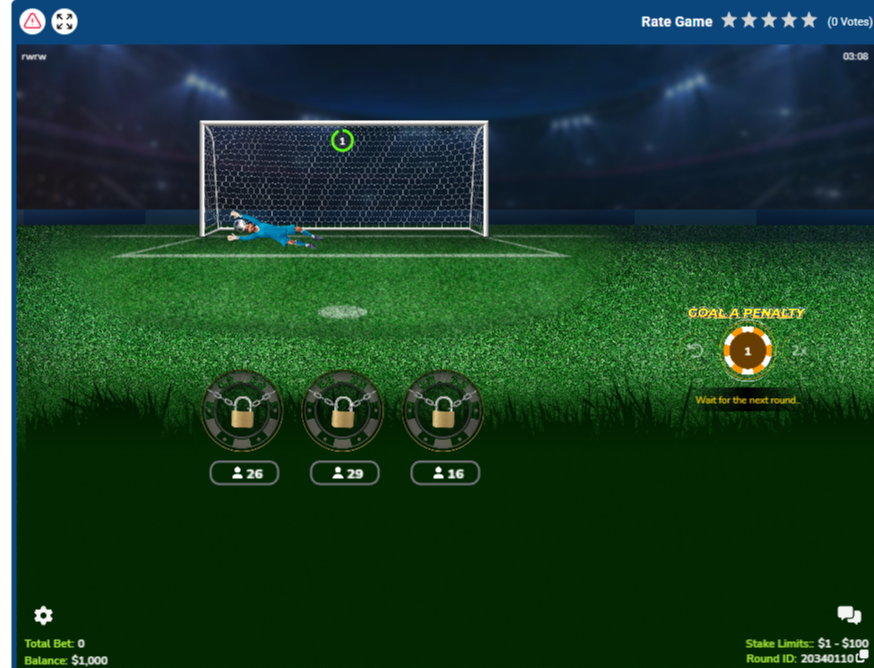
The core of Goal a Penalty is a recurring 11-second betting window. During this brief period, players must place their wagers on one of three potential outcomes of the impending penalty kick. The choices are straightforward and mutually exclusive: Goal (the kicker scores), Save (the goalkeeper blocks the shot), or Out (the kicker misses the goal frame entirely). A correct prediction on any of these outcomes yields a fixed payout of 2.5 times the amount wagered on that specific result. This fixed multiplier is a critical piece of the game's architecture. Unlike the variable payouts in a slot machine, where symbol values and combinations determine the return, here the reward is constant. The challenge lies entirely in correctly forecasting the event.
What elevates this simple choice is the social data presented on screen. Beneath each of the three betting circles—”Goal,” “Save,” and “Out”—is a counter displaying the number of other players who have placed their bets on that outcome for the current round. This creates a visible representation of crowd sentiment, almost like a real-time polling system. A player might see a heavy bias toward “Goal,” prompting a decision: do they ride the wave of popular opinion, or do they take a contrarian position, perhaps believing the odds favor an upset like a “Save”? This feature transforms the game from a simple game of chance against the house into a more complex psychological exercise against a visible, albeit anonymous, group of peers.
The financial model of Goal a Penalty is transparent. A correct prediction returns 2.5 times the stake. This means if you bet $10 on “Goal” and the ball hits the back of the net, your return is $25 (a $15 profit). However, the game’s official Return to Player (RTP) is listed at 83.33%. This figure is substantially lower than the 95-97% range commonly found in contemporary video slots. Experienced players should recognize this as a key characteristic of the game's high-volatility model. The lower RTP suggests that while individual wins are significant (a 150% profit on stake), the frequency of these wins will be lower over the long term to maintain the house edge. This is a deliberate design trade-off for the game's straightforward, high-impact payout structure.
Gameplay Loop and Strategic Considerations
Once the 11-second betting timer expires, all wagers are locked, and the game transitions to the resolution phase. The screen is dominated by the animated sequence of the penalty kick. A player avatar runs up to the ball and strikes it, while a goalkeeper avatar reacts. The entire sequence is brief, lasting only a few seconds before the outcome is determined and displayed clearly on the screen. Winning bets are paid out instantly, and the game immediately resets for the next round, beginning a new 11-second betting window. This rapid, continuous cycle ensures a high-tempo experience with minimal downtime between rounds.
The primary strategic element revolves around interpreting the social betting data and managing one's own betting pattern. A player can place wagers on one, two, or even all three outcomes in a single round, though each bet is independent. Placing a bet on all three options is a financially unsound move, as wagering one unit on each (totaling 3 units) can at best return 2.5 units, guaranteeing a net loss. A more nuanced approach might involve hedging by betting on two of the three outcomes. For example, a player might place a larger wager on “Goal” (the perceived most likely outcome) and a smaller, protective wager on “Save.” This mitigates risk but also caps the potential profit.
Ultimately, the outcome of each round is governed by a Random Number Generator (RNG), specifically the “iMoon RNG V3” as stated in the game's information panel. This means that despite the social indicators, the result is not influenced by player betting patterns. The crowd's wagers have no causal effect on whether the kick is a goal, a save, or a miss. The social data serves as a guide to popular sentiment, not a predictor of a guaranteed outcome. The real game becomes one of personal risk assessment against a backdrop of public opinion, all while knowing the final result is statistically random.
Stadium Atmosphere and Minimalist Design
The visual presentation of Goal a Penalty is clean, functional, and thematically appropriate. The game unfolds against the backdrop of a packed soccer stadium at night, with bright floodlights illuminating the field. The art style is realistic but not photorealistic, opting for clear, computer-generated graphics that prioritize function over elaborate detail. The focal point is always the penalty area—the goal, the keeper, and the ball. This minimalist approach prevents any visual clutter from distracting the player during the critical 11-second betting phase.
The animations are simple and serve their purpose effectively. The run-up of the kicker, the strike of the ball, and the dive of the keeper are rendered smoothly. There are several different shot outcomes animated—balls going into the top corners, straight down the middle, saves pushed wide, or shots that miss the goal completely. While these animations become repetitive over successive rounds, their primary function is to serve as a visual reveal for the randomly generated outcome. The most effective visual effect is the clear, decisive text that appears post-shot—”GOAL,” “SAVE,” or “OUT”—instantly confirming the result and leaving no room for ambiguity.
The sound design complements the minimalist visuals. The ambient audio consists of a low, continuous murmur of a stadium crowd, which helps build a sense of occasion. During the betting phase, a subtle, ticking clock sound effect adds to the urgency. The climax of each round is punctuated by the sound of the ball being kicked, followed by either the cheer of the crowd for a goal, a collective gasp for a miss, or the thud of the ball hitting the keeper's gloves. Like the graphics, the audio is functional and enhances the theme without becoming overbearing. It’s a design philosophy that suggests iMoon wants the player’s attention squarely on the betting decision itself.
A Look at iMoon and Game Integrity
Goal a Penalty is a product of iMoon, a developer that has carved out a niche in the online gaming space by focusing on alternative game formats. Rather than competing directly in the saturated video slot market, iMoon often produces instant-win, crash-style, and social betting games. Their portfolio reflects a commitment to simple, fast-paced mechanics and transparent odds, catering to a player base that may be looking for experiences beyond traditional slots. This game is a prime example of their design ethos: take a universally understood concept (a penalty shootout) and build a simple, engaging betting mechanic around it.
The technical specifications provided within the game itself speak to a level of transparency. The stated stake limits of $1 to $100 per outcome provide a clear range for players. The max win potential of $100,000 is an impressive ceiling, though achieving it would require sustained success at maximum stakes. Most importantly, the explicit mention of the “iMoon RNG V3” is a statement of integrity. By naming their specific RNG version, the developer is assuring players that the outcomes are certified and statistically random, a crucial element for building trust in any real-money or free-play online game. While the 83.33% RTP is a data point that players should carefully consider in relation to their own preferences for game volatility and return rates, its upfront disclosure is a mark of a responsible provider. This game is a well-executed concept for players who appreciate directness and can look past the low RTP in favor of the straightforward 2.5x multiplier and engaging social dynamic.