
Face the undead in InOut’s Chicken vs Zombies! This crash game offers a 95.5% RTP and player-set volatility. Push your luck, grow the multiplier, and cash out!
 Chicken vs Zombies
Key Game Features
| Feature Name | Description | Trigger / How it Works |
|---|---|---|
| Crash Game Mechanic | The player's goal is to advance through a path, increasing a multiplier with each successful step. | Press the “Go” button to take a step. The player can cash out at any time. |
| Manual Cash Out | Players have full control to end the round and collect their current winnings at any point. | Click the “Cashout” button before getting caught by a zombie. |
| Adjustable Difficulty | Four difficulty levels (Easy, Medium, Hard, Hardcore) alter the game's risk and reward profile. | Select the desired difficulty level from the dropdown menu before starting a round. |
| Progressive Multiplier | The payout multiplier increases with each zombie successfully passed. | The multiplier for the next step is displayed on the upcoming tombstone. |
| Provably Fair | The game uses cryptographic technology to ensure and verify the fairness of each round's outcome. | Players can check the client and server seeds in the game's settings. |
What is Chicken vs Zombies and How Does It Work?
Chicken vs Zombies is a type of Instant Win Game that utilizes a crash game framework. A player determines a bet amount, selects a difficulty setting, and presses ‘Go' to begin a round. The chicken character moves forward, and with each successfully passed zombie, the prize multiplier increases. The main objective is to press the ‘Cashout' button to secure the current multiplier before the chicken is caught, an event that concludes the round and forfeits the initial bet.
The entire gameplay loop hinges on direct risk management. Traditional online slots you can try present a spin's result instantly. This game unfolds step-by-step, making the player's decision the primary factor between winning and losing. The Chicken vs Zombies demo provides an excellent environment to learn this mechanic without financial risk.
Gameplay Mechanics: A Game of Nerve and Timing
The game's mechanics are simple in their design but create complex scenarios in practice. All elaborate bonus features are removed to focus the player on a single, tense decision that repeats with escalating stakes.
The Core Loop: Advance or Cash Out?
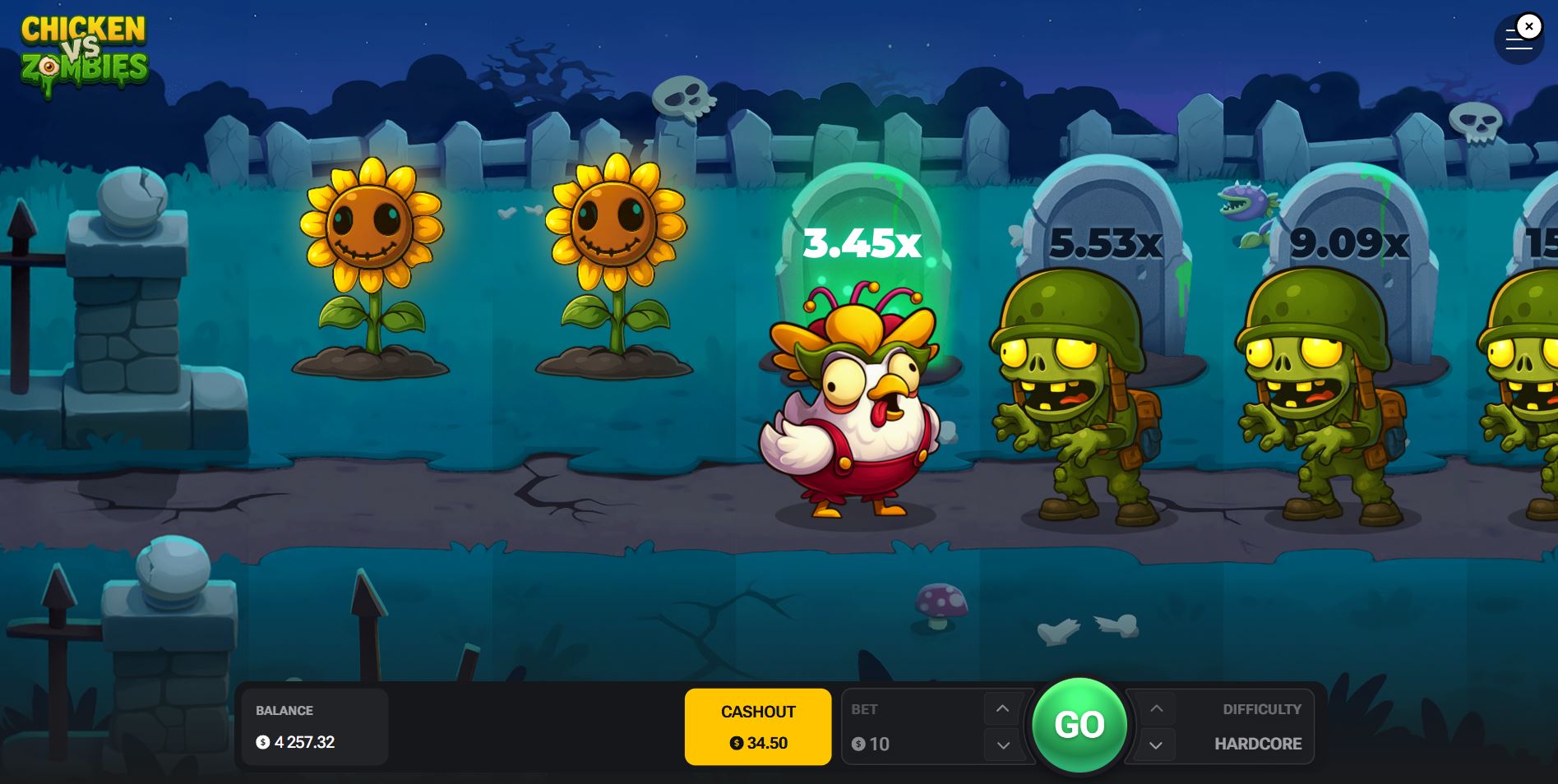
You are presented with a path marked by tombstones. Each one conceals either a safe passage or a zombie. Pressing “Go” prompts the chicken to advance. If the way is clear, a sunflower appears, the win multiplier updates to the value shown on that tombstone, and you must make the choice again. This process repeats until you either press “Cashout” or a zombie appears. The emergence of a zombie instantly ends the round, and the wager is lost. This mechanic establishes a powerful dynamic where unchecked ambition leads to failure.
How Do Difficulty Levels Change the Game?
The adjustable difficulty setting is the strategic heart of Chicken vs Zombies. It grants you direct control over the game's volatility.
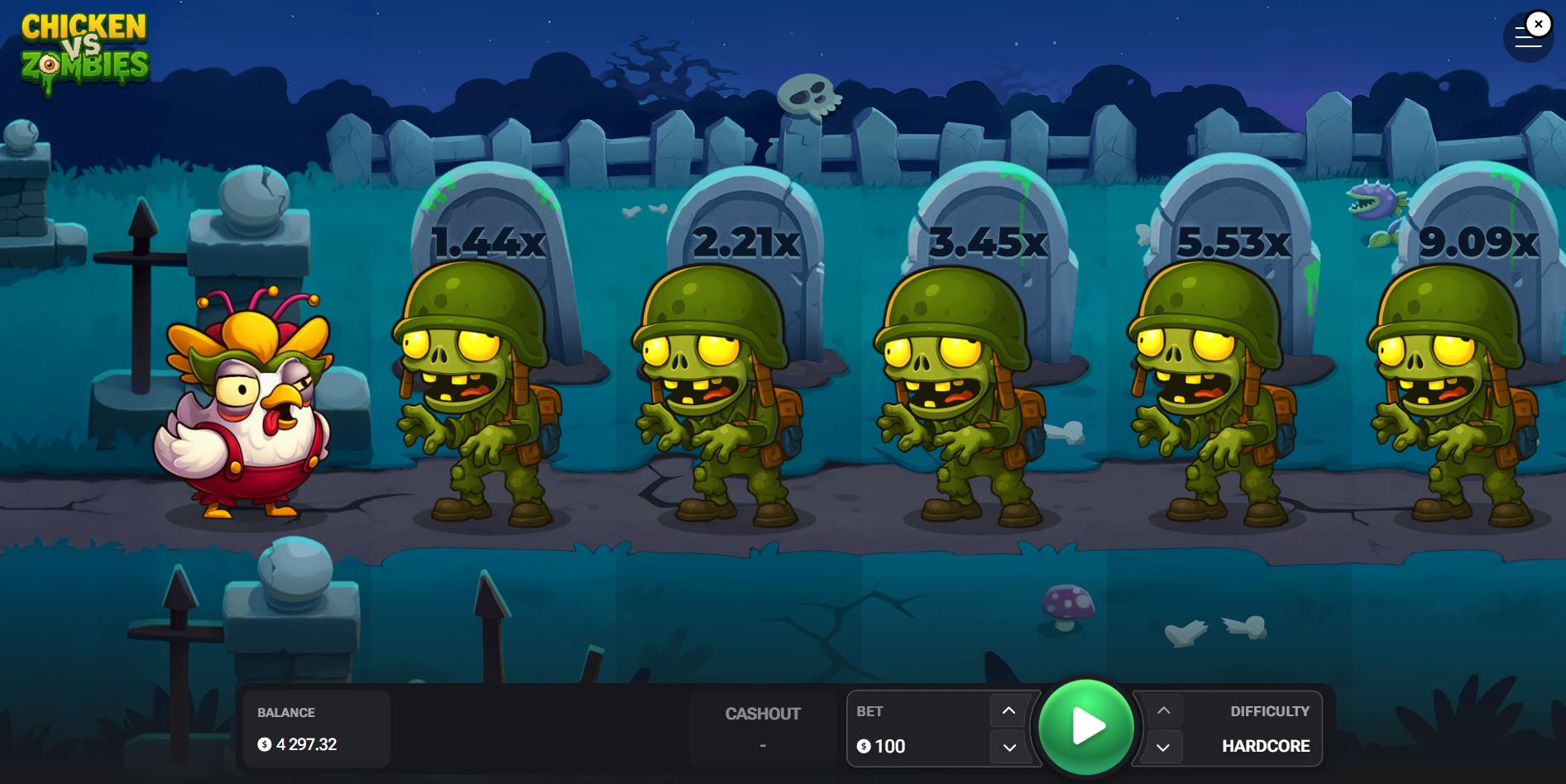
There are four distinct levels. Easy mode features a path with 30 zombies to defeat, where multipliers increase in small increments. In contrast, Hardcore mode has a path with only 18 zombies. While the probability of losing on any single step is higher on Hardcore, the multipliers increase at a much faster rate. A successful 4-step journey on Hardcore yields a multiplier that might require 12 or more steps to achieve on Easy. Your difficulty choice is a direct trade-off between longer, lower-risk runs and short, high-risk runs with exponential potential.
Unpacking the Multiplier System's Math
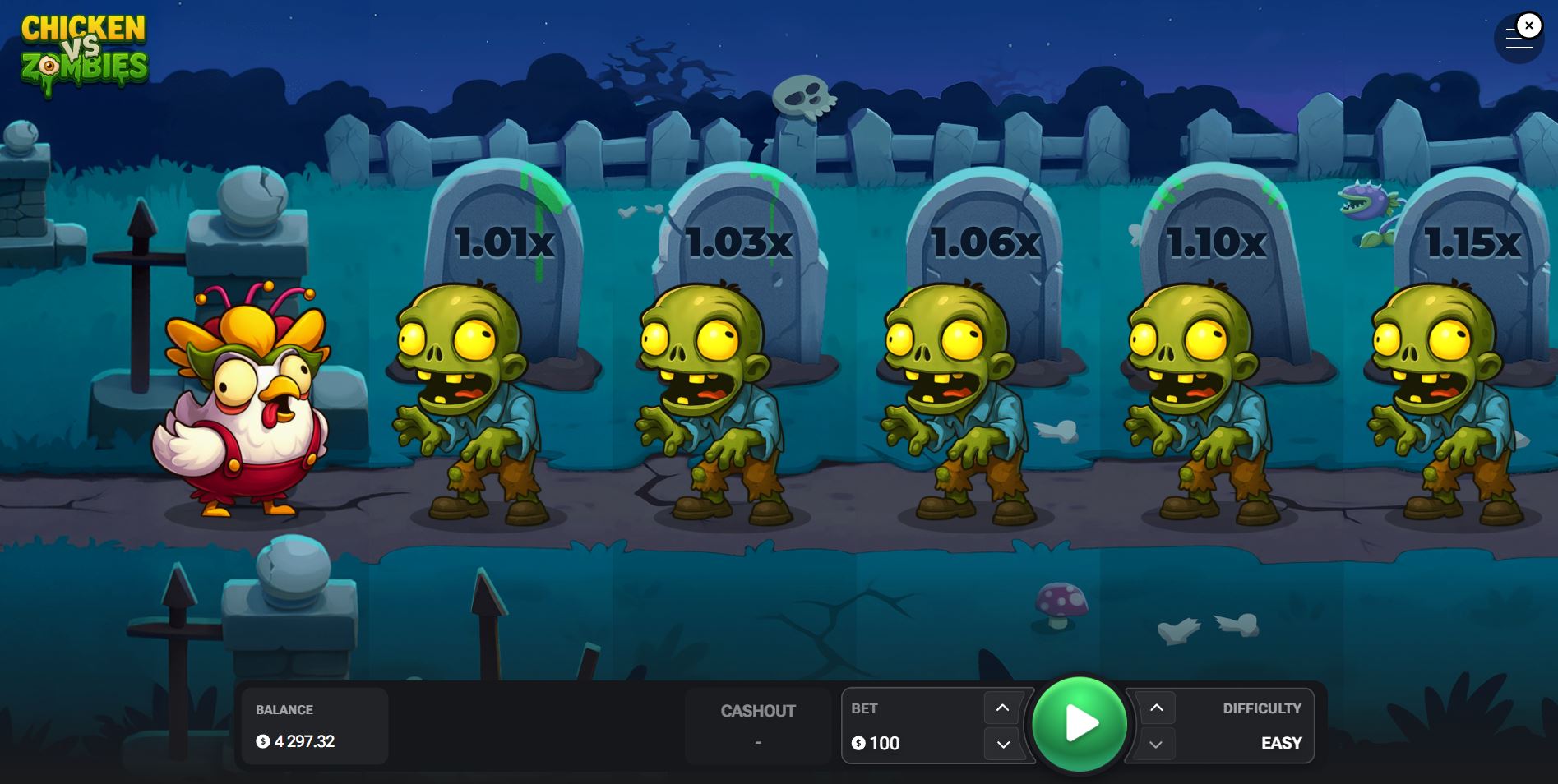
Each tombstone on the path clearly displays the multiplier you will secure upon reaching it. On the Easy setting, the first step is worth 1.01x. On the Hardcore setting, this first step is 1.44x. This transparent display allows for precise risk-reward calculation. If you bet 10 credits and attempt a step valued at 3.45x, you are consciously risking those 10 credits for a potential 34.5 credit payout. This level of tactical information is uncommon and makes the Chicken vs Zombies slot demo a valuable learning tool.
Audiovisual Theme: A Cartoon Apocalypse
The game's aesthetic combines a Horror setting with a comedic tone. The action takes place in a spooky graveyard at night, but the cartoon art style keeps the atmosphere from becoming too grim. This blend creates a unique Zombie game. The chicken protagonist is comically determined, and the zombies are more goofy than scary. Their appearance changes based on the difficulty—standard shamblers give way to zombies in football gear and military helmets, adding visual feedback to your strategic choices.
Sound design is sparse but impactful. The suspenseful music, the sound of a vanquished zombie, and the sharp audio cue when you're caught all heighten the tension. The sunflower that appears on a safe step is a clear, charming homage to the classic tower defense game “Plants vs. Zombies,” rewarding the player with a positive, recognizable symbol. The whole presentation is part of a package filled with personality, much like the Animal-themed chaos in Le Cowboy.
Decoding the Chicken vs Zombies Mathematical Model
The intuitive gameplay is built on a precise mathematical structure that dictates odds and potential returns. A grasp of this structure is foundational to developing a strategy.
The Mathematical Paradox of Player Agency
The paradox of Chicken vs Zombies is how player psychology directly impacts the game's financial model. The game has a fixed theoretical RTP of 95.5%, which corresponds to a 4.5% house edge on every probabilistic event. But unlike a slot machine, you decide how many of these events you are exposed to in a winning round. A player who consistently cashes out at a 1.10x multiplier is engaging with the game's math in a fundamentally different way than a player who always aims for a 5x multiplier. Your personal return rate is therefore a product of the game's math and your own nerve. The game is Provably Fair, but your results are a reflection of your strategy.
Player-Controlled Volatility: Your Key to Strategy
This is the game's defining mechanical feature. Your choice of difficulty directly sets the volatility.
- Low Volatility (Easy/Medium): The strategy is to accumulate frequent, smaller wins. The risk per individual step is minimized, but a long sequence of successful steps is required to reach a large multiplier.
- High Volatility (Hard/Hardcore): This strategy accepts a high probability of failure on any given step in exchange for rapidly increasing multipliers. It is a hunt for short, explosive wins. The experience is not unlike the all-or-nothing feeling of high-volatility releases from Nolimit City such as Outsourced.
Betting Limits and Max Payout Potential
The game's betting range is wide, from a minimum of $0.01 to a maximum of $5,000 per round. The absolute maximum win from a single game round is capped at $5,000. This cap is a crucial piece of information, particularly for high-rollers playing on Hardcore, where multipliers can theoretically ascend to very high values.
Self-Control Advisory:
The “one more step” impulse in this game is intense. A useful discipline to practice in the demo is to define a clear objective before you start. Decide you will cash out at 3x, for example, and stick to it. This trains you to execute a plan instead of reacting to emotion, a valuable skill in any game involving risk.
Expert Strategies for the Chicken vs Zombies Demo
Using the free play mode is about more than just entertainment; it’s for collecting data and honing your discipline. Use the demo to test different approaches and find a rhythm.
What If the Game Had a “Safe Step”?
Let's imagine a design change: What if, after every 5 consecutive successful steps, the game awarded a single “safe step” on the next press of “Go”? This safe step would not increase the multiplier, but it would guarantee you cannot bust. How would this alter the game? It would introduce mini-goals within a round, transforming the risk calculation. A player who just reached step 5, 10, or 15 would be incentivized to use the free step to bridge to a higher multiplier tier. It would shift the dynamic from a constant, linear risk to a more rhythmic, wave-like pattern of tension and release. An interesting thought.
The Contrarian View: Why “Hardcore” is the Best Place to Start
Common sense suggests starting on Easy. I propose the opposite. In the demo, your first 30 minutes should be on Hardcore. Why? Because it will teach you humility faster than any other mode. You will lose frequently and quickly. This experience immediately demonstrates the game's potential for sudden failure. It forces you to respect the risk. After being humbled by Hardcore, the Easy and Medium modes will feel far more manageable. You'll have a much stronger appreciation for the relative safety of the lower levels and will be less prone to greed.
A Brave Chicken's Diary: Session Report
To understand the game's flow, I dedicated time to a 300-round simulation in the demo, starting with a 5,000-credit balance.
My plan was to alternate difficulties and bet sizes to feel the different volatilities. I started with a 2-credit bet on Easy. The successful runs were consistently long, often reaching 8-10 steps and yielding multipliers between 1.5x and 2.0x. Cashing out was a frequent and low-stress decision. My balance remained stable. After around 50 rounds, I switched to a 2-credit bet on Hardcore. The shift was jarring. Bust. Bust again. Most rounds ended within two steps. But then, a three-step success paid 6.90 credits from a 3.45x multiplier. The wins were rare but potent.
The session's most instructive moment came from a brief “hot streak” on Hard mode with a 50-credit bet. I hit a 4-step run for a 2.31x multiplier, cashing out with over 115 credits. Emboldened, I let the next run go… and busted on the second step. The balance, which had climbed to around 5,200, dipped back below the starting point. This perfectly encapsulates the psychology of the game; one moment of greed can erase ten careful wins. After 300 rounds, my balance was 4,897 credits, a small loss, but the experience gained in managing risk was invaluable.
How Does Chicken vs Zombies Compare to Other Games?
Understanding where this game fits in the broader landscape of casino entertainment helps appreciate its unique appeal.
Crash Games vs. Traditional Slots
A traditional slot machine, like the popular Book of Ra Magic, is a game of pure chance. You spin the reels, and the outcome is determined by an RNG. A crash game introduces a critical element of player skill and timing. While RNG still determines if a zombie will appear at a given step, you decide when to stop and collect your winnings. This active participation is the key difference and appeals to a player base that wants more control over their game. It transforms the experience from passive observation to active risk management.
Thematic Relatives in the Zombie Genre
While mechanically distinct, Chicken vs Zombies shares its apocalyptic theme with many popular slots. If you enjoy the blend of dread and action, the zombie-infested ride in Train to Seoul offers a more conventional slot experience with a similar survival horror vibe. For those who prefer a more ancient and mystical take on the undead, the Egyptian-themed Cursed Crypt from Hacksaw Gaming provides a thrilling reel-based adventure. These games prove that the undead genre has many forms.
Little-Known Facts About the Game
- Homage to a Classic: The appearance of a Sunflower after a successful step is a direct, intentional nod to the iconic “Plants vs. Zombies” game, functioning as a positive visual reward.
- Verifiable Fairness: The game operates on a Provably Fair system. This allows players to independently verify that the game's outcomes are random and not manipulated by using cryptographic hashes of server and client seeds.
- Purely Manual Control: Many crash games include an ‘auto cash-out' feature. InOut deliberately excluded this, ensuring the decision to continue or stop rests entirely on the player's shoulders every single round, amplifying the psychological tension.
The Streamer's Scorecard: Is It Watchable?
How does Chicken vs Zombies fare as a spectacle for platforms like Twitch or YouTube? Let's break it down.
- Visual Appeal: The colorful, cartoonish graphics are clean and easy to read on stream. The animations are simple but effective, making the action clear to viewers. It’s visually pleasant.
- “Big Win” Potential: This is its strongest asset. The tension of a streamer pushing their luck on a long run on Hardcore mode is content gold. The sudden bust or the triumphant cash-out creates huge emotional peaks perfect for viewer reactions and clips.
- Dynamics: The game is rapid-fire. There's no dead time between rounds. This keeps the stream moving and the audience engaged. The streamer is constantly making decisions, which fuels commentary.
Verdict: Highly recommended for streaming. The game's core loop is practically designed for creating suspenseful, shareable moments. The direct link between the streamer's nerve and the outcome makes for compelling viewing.
Vlad Hvalov's Expert Take:
“People coming from slots are used to thinking about volatility as a fixed attribute. Here, you are the volatility setter. My advice for the demo? Play 20 rounds on Easy, then 20 on Hardcore with the same bet. Don't even focus on winning; just watch the rhythm of the game. You'll learn more about risk in those 40 rounds than in 400 spins on a standard slot.”
Final Thoughts: Is Chicken vs Zombies Worth Playing?
So, what’s the final call on this undead-infested escapade? Honestly, it's a breath of fresh air. It’s a challenge of nerve presented in a charming, funny package. This game won't appeal to players who want to sit back and watch reels spin on auto-play. It demands your attention. It demands you make a choice.
The ability to test your own risk tolerance in the Chicken vs Zombies free play mode is its greatest strength. It’s a perfect tool for learning the psychology of gambling—when to push, when to retreat. InOut has crafted a game that is less about the theme (though it is entertaining) and more about the raw, unfiltered experience of risk. For players looking for something interactive that puts their decision-making at the forefront, this is an absolute must-try. It's a testament to the idea that the most engaging gameplay can come from the simplest of choices. I recommend it.
FAQ
Is Chicken vs Zombies a traditional slot game?
No, it is a crash game where players decide when to cash out their winnings as a multiplier increases, rather than spinning reels to match symbols.
What does the ‘Difficulty' setting do?
The difficulty setting adjusts the game's volatility; Hardcore mode has fewer steps but much faster multiplier growth, while Easy mode has more steps with smaller, incremental increases.
What is the RTP of Chicken vs Zombies?
The theoretical Return to Player (RTP) for Chicken vs Zombies is 95.5%.
What is the main strategy to win?
The key strategy is disciplined risk management: setting a target multiplier before the round starts and cashing out once you hit it, avoiding the temptation of “one more step.”
Can I play Chicken vs Zombies for free?
Yes, a full-featured demo version of Chicken vs Zombies is available to play for free on Respinix.com.
Who is the developer behind this game?
Chicken vs Zombies was developed by InOut, a provider known for creating innovative instant win and crash games.
What is the maximum win in the game?
The maximum achievable win in a single round of Chicken vs Zombies is capped at $5,000.
Is the game's outcome truly random?
Yes, the game uses a Provably Fair algorithm, allowing players to cryptographically verify the randomness and fairness of each round.