THNDR’s Blocks presents a competitive puzzle environment that intentionally diverges from mechanics of chance. The game’s core is built on a minimalist aesthetic, utilizing a clean 9×9 grid where strategic thinking is paramount. Players engage in a skill-based contest, aiming to outscore an opponent by placing a series of identical shapes to clear lines and 3×3 squares. Because performance is tied directly to player cognition, traditional metrics like RTP and volatility are not applicable. The strategic depth comes from its two primary bonus features: persistent score multipliers and escalating Point Tiles. Activating multipliers early is crucial for maximizing long-term score potential. This system creates a compelling dynamic where players must constantly balance immediate board-clearing against preserving high-value point tiles for the final rounds, making every move a calculated decision. The experience rewards foresight and efficient spatial management above all else.

THNDR's Blocks presents a framework that deviates substantially from the common chance-based mechanics prevalent in many online games. It positions itself as a contest of spatial reasoning and long-term planning, where the primary driver of success is player cognition rather than random outcomes. The game centers on a competitive puzzle format where two individuals tackle an identical sequence of shapes on separate boards. Its core appeal is built upon two interconnected systems: a persistent point multiplier and escalating bonus tiles. These elements create a deep layer of strategic tension, forcing constant evaluation of short-term gains versus long-term scoring potential. This is not a passive activity; it demands sustained focus and foresight from the first move to the last.
The Duality of Scoring: Multipliers and Point Tiles
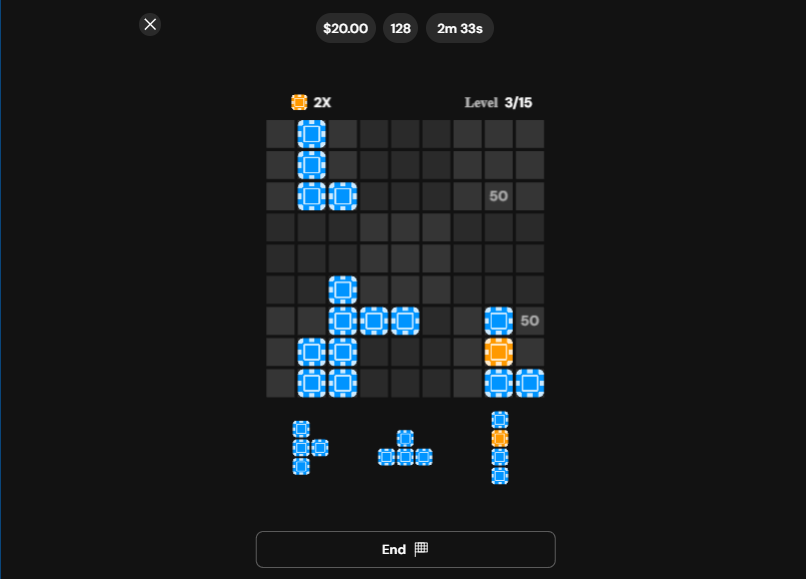
The scoring architecture in Blocks is multifaceted, rewarding both immediate actions and strategic patience. At its most basic level, points are awarded for placing shapes on the 9×9 grid, with each constituent square of a shape contributing one point. Completing any full row or column, or filling one of the nine 3×3 squares, clears those blocks and grants a flat award of 20 points. This foundational system encourages efficient board clearing and space management, but it is the interaction of the two primary bonus mechanics that defines the game's strategic depth.
The first and arguably most critical mechanic is the persistent point multiplier. Within each of the game's 15 rounds, players receive a set of three shapes to place. One of these shapes will contain a distinctly colored block—the multiplier tile. When the line or 3×3 square containing this specific block is cleared, the game's overall score multiplier increases. This increase is permanent for the remainder of the match. The profound impact of this system cannot be overstated. A multiplier activated in round 2 will amplify every single point-scoring action for the subsequent 13 rounds, whereas a multiplier captured in round 14 provides a benefit for only a fraction of the game. This creates an immediate and pressing objective from the very start: identify and activate these multipliers as early as physically possible. Delaying their activation directly curtails the maximum achievable score, turning early rounds into a calculated rush to clear specific areas of the board.
Complementing this is the Point Tile system. Periodically, tiles marked with a numerical value (starting at 50) will appear on the grid. Placing any part of a shape over one of these tiles immediately adds its value to your score, which is then affected by your current multiplier. The complexity arises from how these tiles evolve. A maximum of three Point Tiles can exist on the board at once. When a fourth is due to appear, it instead overwrites one of the existing tiles, significantly increasing its value.
Visual Presentation and Interface Functionality
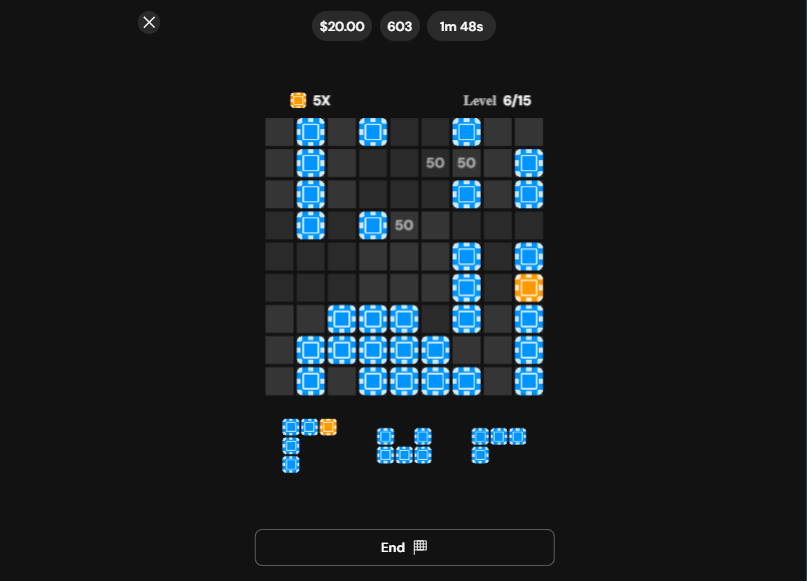
The aesthetic of Blocks is one of stark functionalism. There are no elaborate backdrops, character animations, or distracting visual effects. The entire focus is on the dark gray grid, the vibrant blue player shapes, the orange multiplier blocks, and the numbered Point Tiles. This minimalist approach is a deliberate design choice that serves the gameplay directly. By removing all superfluous visual information, the game allows players to concentrate entirely on the puzzle at hand—the spatial relationships between the shapes and the empty cells on the board. The color-coding is clear and immediate, allowing for rapid identification of critical game pieces without ambiguity.
The user interface is built around this principle of clarity. Key information is displayed cleanly at the top of the screen: the current score, the active multiplier level, and the round counter (e.g., “Level 6/15”). A timer is also present, serving as a constant reminder of the session's finite duration. Below the main grid, the three upcoming shapes are displayed, which is essential for forward planning. A player can see the immediate challenge and begin to mentally map out placement possibilities for the current trio of shapes. The game's animations are subtle and utilitarian. Placing a shape results in a soft, satisfying click, and clearing a line or square triggers a quick dissolution effect that cleanly removes the blocks without disrupting the flow of play. This polished, unobtrusive presentation ensures that the interface facilitates, rather than hinders, the cognitive demands of the game.
Gameplay Pacing and Session Structure
A match in Blocks is rigidly structured into 15 rounds, with a hard time limit for the entire session. In each round, the player must place a specific set of three shapes onto the grid. The sequence of shapes is predetermined and identical for both competitors, removing random chance from the equation and placing the emphasis squarely on execution. The game concludes in one of two ways: either the player successfully places all shapes through 15 rounds, or they reach a state where none of the three current shapes can be fitted into the available space on the grid. This latter condition results in an immediate end to the game, with the current score being finalized.
The time limit introduces a layer of pressure that governs the pace of decision-making. Importantly, there are no point bonuses for finishing quickly. The timer's sole function is to act as a hard stop. This encourages efficient, but not necessarily rushed, play. A player must analyze the board, consider the three available shapes, and make a placement decision within a reasonable timeframe. Dwelling too long on a single move can jeopardize the ability to complete all 15 rounds. This structure rewards players who can quickly process spatial information and identify optimal or at least viable placements without succumbing to analysis paralysis. The round-based system also creates a distinct rhythm, with each new set of three shapes presenting a fresh, self-contained puzzle within the larger context of the overall board state.
Strategic Execution and Cognitive Demands
Success in Blocks hinges on a player's ability to manage multiple conflicting priorities simultaneously. The most fundamental skill is board management. A player must constantly think about not just clearing lines, but the quality of the space being left behind. Creating single, isolated empty cells is a critical error, as these “dead squares” are exceptionally difficult to fill and can lead to a premature end-game scenario. The ideal strategy involves keeping the center of the board as open as possible to accommodate the larger, more awkward shapes that will inevitably appear.
Beyond this, the primary strategic tension lies in balancing the “Multiplier Rush” with “Point Tile Preservation.” An optimal game often involves an aggressive early-game focus on activating multipliers. This may mean forgoing some immediate line-clearing points or even placing a shape in a slightly suboptimal position if it guarantees the capture of a multiplier block. Once a respectable multiplier (e.g., 4x or 5x) is established, the strategy can pivot towards nurturing and eventually capturing the high-value Point Tiles in the final rounds. This requires exceptional foresight, as one must leave a path to these valuable tiles while still managing the influx of new shapes each round.
The competitive nature, where an opponent faces the exact same puzzle, adds a psychological layer. Every point left on the table, every inefficiently cleared line, is a direct opportunity for the opponent to pull ahead. For instance, using a 4-block straight piece to clear a single line is far less efficient than using it to clear a line that also contains a multiplier block or sets up a subsequent clear with the next shape. For players shifting from games of pure chance, this direct correlation between decision quality and outcome provides a substantial and rewarding intellectual challenge. The satisfaction comes not from a lucky spin, but from the successful execution of a multi-round plan. Conversely, those accustomed to more passive entertainment may find the constant need for calculation and strategic adjustment to be quite demanding.