
Blackjack Classic by 7777 Gaming presents the venerable card game with a focus on its fundamental elements. The game features a traditional green felt table layout, allowing for intuitive placement of bets across multiple positions. This execution prioritizes gameplay clarity and historical table game atmosphere over elaborate visuals. Adhering to standard rules, the dealer must stand on all totals of 17 or more. Players engage with core Blackjack actions including hitting, standing, doubling down on specific hand totals, and splitting pairs. Insurance provides an optional side bet against the dealer holding Blackjack. Notably, the game features a highly competitive theoretical Return to Player rate of 99.43%.

Blackjack, in its many digital forms, remains a cornerstone of the online casino landscape. While countless iterations exist, the appeal of a well-executed classic version is undeniable. 7777 Gaming enters this space with their offering, Blackjack Classic. This review delves into the specific implementation of this timeless card game by 7777 Gaming, examining its mechanics, ruleset, visual presentation, and overall player experience as depicted in the available information. Our aim is to provide a comprehensive analysis for experienced players, those seeking strategic insights, or individuals simply interested in exploring online versions of familiar table games without financial commitment.
At first glance, Blackjack Classic presents a familiar scenario: the iconic green felt table, standard playing cards, and intuitive betting areas. 7777 Gaming opts for a clean, functional aesthetic that prioritizes gameplay over elaborate thematic distractions. This design choice suggests a focus on delivering a pure Blackjack experience, allowing players to concentrate on decisions and strategy rather than navigating complex interfaces or visually busy environments. The availability of multiple betting positions, visible on the felt layout, is an immediate practical advantage, catering to players who prefer engaging with more than one hand simultaneously. This multitasking capacity can add an extra layer of engagement and decision-making within each round, appealing to those looking to maximize their action or practice applying strategy across several concurrent scenarios.
The core mechanics adhere closely to conventional Blackjack rules. The objective remains clear: build a hand with a total value higher than the dealer's without exceeding 21, or achieve Blackjack (an Ace and a 10-value card dealt as the initial two cards). Card values follow standard practice: numbered cards are worth their face value, King, Queen, and Jack are each worth 10 points, and an Ace can flexible value of 1 or 11 points, depending on which value is most favorable to the hand total. Understanding this fundamental card valuation is the absolute bedrock of any Blackjack play, dictating every subsequent decision a player makes. The game clearly communicates hand totals, assisting players in quickly assessing their position against the dealer's visible card.
Detailed Gameplay Mechanics and Core Rules
Understanding the flow of a round in Blackjack Classic involves recognizing the roles of both the player and the dealer, and the specific rules governing each. After initial bets are placed across the chosen hand positions, the cards are dealt: two cards face up to each player hand, and one card face up and one face down to the dealer. The player then acts on each of their hands sequentially (typically left to right if playing multiple hands), making crucial decisions based on their hand total and the dealer's visible up-card. The fundamental actions available are Hit (take another card to increase the hand total) and Stand (receive no more cards, locking in the current hand total). The outcome of the hand is ultimately determined once all player hands have acted and the dealer has completed their turn according to the house rules.
A pivotal element that defines a specific Blackjack variant is the dealer's hitting rules. In Blackjack Classic by 7777 Gaming, the rules, as detailed in the game's information, state unambiguously: “If the total is less than 17 – the DEALER draws an additional card.” This confirms that the dealer must hit if their hand total is 16 or less (including soft 17), and must stand on any total of 17 or more (including soft 17). This “dealer stands on all 17s” rule is generally favorable to the player compared to games where the dealer hits on soft 17, marginally increasing the house edge in the latter case. Experienced players often specifically seek out games with the dealer stand on 17+ rule due to this slight edge. Once all player hands have either busted (exceeded 21) or stood, the dealer reveals their face-down card and plays their hand according to this fixed rule. Hands are then compared, and payouts are awarded.
Payouts in Blackjack Classic follow the most common structure. A standard winning hand (player hand total higher than the dealer's without busting) pays 1 to 1. A successful Blackjack is paid at the favorable rate of 3 to 2, assuming the dealer does not also have Blackjack. If both the player and dealer have the same hand total, or both have Blackjack, the result is a Push, and the player's bet is returned. A player busting or having a lower hand total than the dealer (without the dealer busting) results in a loss of the bet. This standard payout structure is expected and competitive, reinforcing the game's classical approach.
Exploring Key Player Options: Double Down, Splits, and Insurance
Beyond the basic Hit and Stand actions, Blackjack Classic offers strategic options that significantly influence potential outcomes and introduce layers of decision-making. These include Double Down, Splitting Pairs, and Insurance. Mastering the proper use of these options based on the principles of basic Blackjack strategy is key to minimizing the house edge and achieving the game's theoretical return. The implementation of these options can vary between Blackjack games, so understanding their specifics in the 7777 Gaming version is essential.
The Double Down option allows players to potentially double their winnings when they hold a mathematically strong position after receiving their initial two cards. In this specific iteration of Blackjack Classic, the ability to Double Down is limited to hands with initial two-card totals of 9, 10, or 11 only. When a player chooses to Double Down, they place an additional bet equal to their original wager, and in return, they receive exactly one more card to complete their hand. They cannot request further cards after the single hit. The restriction to totals of 9, 10, or 11 is a notable characteristic of this game; some other Blackjack variants permit doubling on any two cards. Doubling on 9, 10, or 11 is consistent with standard basic strategy for many situations against various dealer up-cards, particularly when the dealer shows a weak card (like a 2 through 6). The strategic advantage here is that these totals have a high probability of becoming a strong hand (like 19, 20, or 21) with a single card draw.
Splitting Pairs provides an opportunity to turn one potentially weak or problematic hand into two independent hands, each with a chance to win. This option becomes available when the player's initial two cards are of the same numerical value (e.g., two 8s, two Kings). Choosing to Split separates the pair into two distinct hands. The player must then place an additional bet on the second hand, equal to their original wager. Each hand receives a new second card, and play proceeds independently for each. The player makes Hit, Stand, and potentially other decisions (like Doubling, if rules permit and conditions are met for the new hands) for the first hand until it is completed (stood or busted), then proceeds to play the second hand similarly. The game information provided does not specify whether re-splitting is allowed if another pair is dealt to a split hand, nor does it detail any specific rules regarding splitting Aces (such as receiving only one card per Ace and not being able to hit further). Based solely on the available information, we can confidently state that splitting matching-value pairs is a feature, and each split hand requires an equal bet to the original.
Insurance is presented as a side bet against the dealer having Blackjack, offered only when the dealer's up-card is an Ace. Electing to take Insurance involves placing an additional wager equal to half of the original main bet. This bet is resolved independently of the player's main hand outcome. If the dealer's face-down card is a 10-value card (resulting in a dealer Blackjack), the Insurance bet pays out at 2 to 1. If the dealer does not have Blackjack, the Insurance bet is lost, and the main hand is then played out as normal. From a basic strategy perspective, taking Insurance is statistically unfavorable over the long term in most situations, regardless of the player's hand. Its inclusion offers an option for players interested in this specific proposition, but it is typically viewed as a side bet that benefits the house edge. The game's clear display of the dealer's Ace makes the opportunity for Insurance unmistakable for players choosing whether or not to engage with it.
For those seeking a detailed understanding of these options, including edge cases or interactions between rules like Doubling after Splitting (which isn't explicitly ruled out or in by the visible information), accessing the comprehensive in-game help is advisable. If you are ever unsure about the specifics of a bonus or function described, launching a demo version of the game and consulting the built-in help system, typically accessed via an ‘i' button within the game interface, will provide the most authoritative information directly from the developer regarding all nuances of the game rules and payout conditions. Engaging with free online demo slots is a practical way to see these features in action and understand their flow before committing actual funds.
Table Presentation, Atmosphere, and Interface
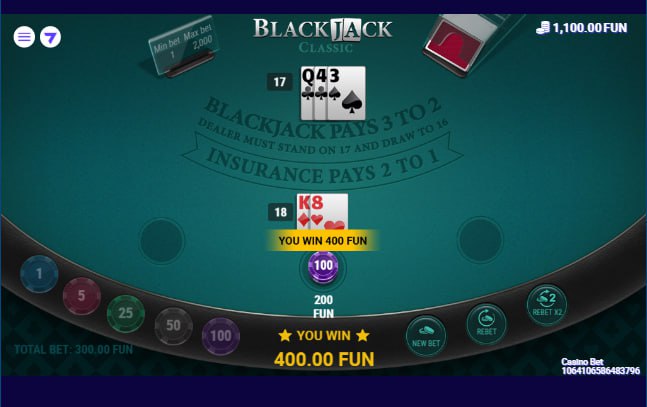
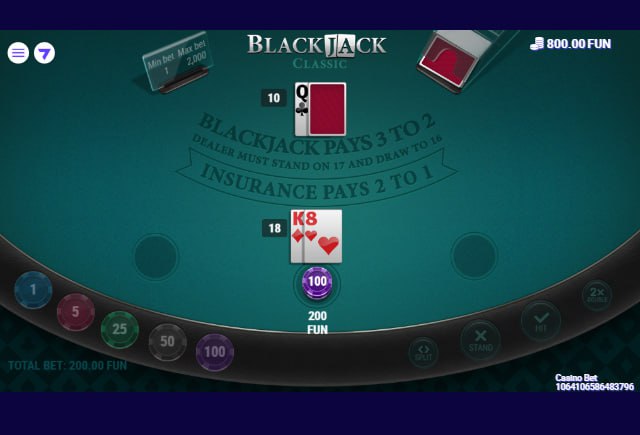
Blackjack Classic by 7777 Gaming adopts a visual style that is both traditional and functional. The predominant color scheme revolves around the rich green of the Blackjack table felt, creating an immediate association with physical casino environments. This deliberate lack of ostentatious graphics or complex animations reinforces the “Classic” in the game's title, aiming for an experience that feels grounded and focused on the core game. The cards themselves appear clearly designed, with legible ranks and suits, crucial for rapid interpretation during fast-paced gameplay or when managing multiple hands. The interface elements – chip stacks, betting circles, and action buttons – are laid out logically and unobtrusively.
The user interface provides the necessary tools without clutter. Players select chip denominations from a standard set, intuitively placing them in the betting areas designated for each hand they wish to play. The ability to choose multiple hand positions (visually appearing as three distinct spots on the felt based on the screenshots) is a significant interface feature that accommodates different playing styles, from focusing on a single hand to managing several simultaneously. Action buttons like Hit, Stand, Double, Split, Deal, Clear Bets, Repeat Bet, and New Game are readily accessible, typically positioned in a consistent and ergonomic manner. The game appears to handle standard visual cues such as highlighting the active hand, showing accumulated totals clearly near the cards, and providing simple win notifications, as suggested by the “YOU WIN” message visible in the gameplay screenshots. While highly detailed animations are not the focus, expect standard table game effects like cards being dealt smoothly onto the felt and chips stacking in the betting areas upon a win. This functional visual feedback is crucial for players to follow the game's progression effortlessly. The atmosphere, thus, is one of quiet concentration on the probabilities and decisions of Blackjack, rather than an immersive, highly animated world.
The Developer's Approach: 7777 Gaming's Classic Blackjack
7777 Gaming, as a developer, demonstrates a clear intention with Blackjack Classic: to deliver a solid, standard version of the game accessible to a wide audience. Their decision to implement common and player-favorable rules, such as the dealer standing on all 17s and the 3:2 payout for Blackjack, positions this game as a competitive option among classic online Blackjack titles. While the rule limiting Doubling to 9, 10, or 11 is slightly more restrictive than some variants, it aligns with standard basic strategy in key scenarios. This particular ruleset appeals to players who value traditional play and can leverage these specific rules within a well-established strategy framework.
Perhaps the most compelling detail regarding 7777 Gaming's implementation, explicitly provided within the game's “Legal Notices” information, is the stated Theoretical Return to Player (RTP) of 99.43%. This is an exceptionally high RTP for any casino game, particularly table games, signifying a very low house edge (0.57% if played with optimal strategy). A high RTP indicates that, over a vast number of game rounds, the game is designed to return a significant portion of wagered money to players. This figure is critical for serious players who consider volatility and long-term expected outcomes. The high RTP in Blackjack Classic reflects the inherent nature of Blackjack itself, where skilled play using basic strategy can drastically reduce the house's advantage, and it underscores 7777 Gaming's commitment to providing a version with competitive odds under standard rules.
From a strategic standpoint, the game's specific ruleset (dealer stands on 17+, Double 9/10/11, 3:2 Blackjack payout) means that standard Blackjack basic strategy charts should be consulted with these particular conditions in mind. Minor adjustments might be needed compared to games where the dealer hits soft 17 or allows doubling on any total. Players aiming to play optimally will find that adherence to the strategy derived for these rules is paramount to approaching the advertised 99.43% RTP.
Considering its characteristics, Blackjack Classic by 7777 Gaming is well-suited for several player demographics. It is an excellent choice for newcomers seeking to learn the fundamentals of Blackjack in a clear and uncluttered environment, especially when played as a free online demo slot. The detailed in-game information accessible via the ‘i' icon is invaluable for understanding the rules thoroughly. For experienced players, it offers a straightforward game with a desirable ruleset (dealer stands on 17) and a highly competitive RTP. While it doesn't introduce novel side bets or groundbreaking gameplay features beyond the standard game, its strength lies in providing a reliable, classic Blackjack experience. It represents a solid, functional, and statistically favorable option within the crowded landscape of online table games, prioritizing the strategic depth of Blackjack itself over superficial novelties.