
THNDR’s PvP Blackjack reimagines the classic card game as a focused, strategic competition between two players. The game environment uses a minimalist, digital theme, prioritizing functional clarity over traditional casino ornamentation. Within its unique layout, both opponents play through an identical 10-round sequence of cards from a two-deck shoe. The core objective shifts from simply beating the dealer to out-scoring the other player by making more profitable betting and strategic choices. This design introduces significant volatility, where outcomes are heavily influenced by the game’s primary Bonus Feature. This feature is a progressive Win Streak system that applies escalating multipliers to winnings for consecutive successful hands. A Natural Blackjack further boosts winnings with a 3:2 payout plus an extra 50% chip bonus.

THNDR, a provider known for its competitive gaming integrations, has constructed a version of Blackjack that redefines the game's objective. This is not the familiar contest against a static house edge. Instead, it presents a cerebral, asynchronous competition where the primary opponent is another human player operating under identical conditions. The core of the experience is built on a 10-round match where both participants are dealt the exact same sequence of cards. Victory is not merely achieved by beating the dealer; it is determined by who can more effectively manage their chip stack, leverage scoring multipliers, and ultimately, accumulate a higher total than their mirror-image opponent. The introduction of a progressive win streak bonus system adds a significant layer of strategic depth, forcing players to constantly re-evaluate risk and reward based on their current performance streak.
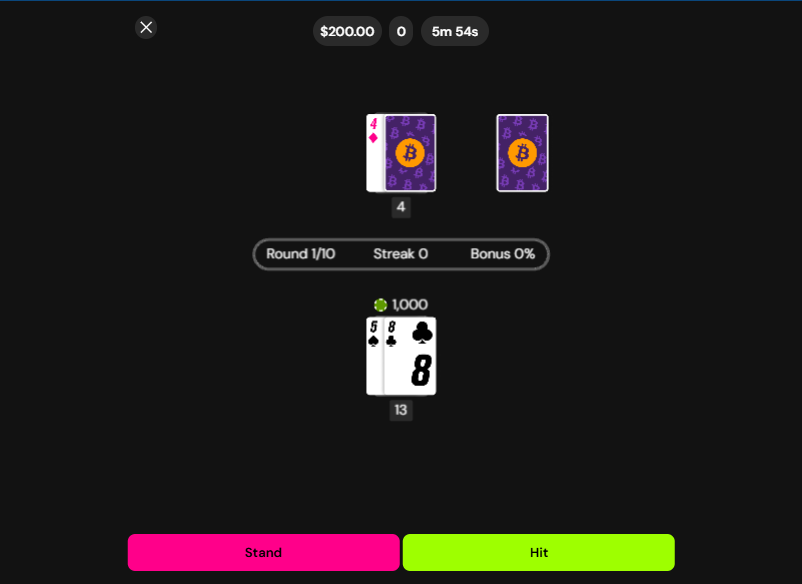
The Core Competitive Framework: Asynchronous PvP
The foundational mechanic of this game is its player-versus-player structure, conducted asynchronously. Each match consists of ten rounds. The critical element is that the card sequence is predetermined and identical for both you and your opponent. This single design choice shifts the game's nature from a game of chance against the house to a game of skill and optimization. If the dealer shows a 6 and you are dealt a 13 in the third round, your opponent faces precisely the same scenario. The outcome of the match hinges on the cumulative results of your decisions versus theirs across these ten identical hands.
A six-minute timer governs the entire 10-round session. Should this timer expire before all hands are completed, the game concludes, and the player's final score is calculated based on their chip balance. It is important to note a critical detail from the rules: chips that are currently wagered on the table when a timeout occurs are not included in the final score. This adds a subtle pressure to play efficiently, although the speed of individual decisions does not directly influence scoring. The challenge lies in making the most profitable choices within the allotted time frame, knowing your adversary is solving the same ten puzzles. The winner is simply the player with the greater number of chips at the end of the match.
The game is a test of who can better navigate the highs and lows of the deal. If a particular hand results in a dealer Blackjack, both players will experience it. The difference in outcome is created by the betting. A player who made a conservative bet will lose less than an opponent who wagered heavily on that same hand. The entire 10-round arc becomes a fascinating exercise in relative performance.
Strategic Depth Through Win Streaks and Bonuses
The primary mechanism for creating a score differential lies within the game's bonus structure, which heavily rewards consistency. While a standard win against the dealer results in a 1:1 payout, the system introduces powerful multipliers that can dramatically alter the course of a match. A Natural Blackjack (an Ace and a 10-point card on the initial deal) pays at the standard 3:2 ratio but also provides an additional +50% bonus to the chips won for that specific round. This immediately creates a significant scoring opportunity.
The most influential feature is the Win Streak Bonus. This system applies a progressively increasing percentage bonus to winnings based on the number of consecutive hands won. The scaling is aggressive and forms the central pillar of advanced strategy:
2 consecutive wins: +20% chip bonus
3 consecutive wins: +30% chip bonus
4 consecutive wins: +50% chip bonus
5 consecutive wins: +80% chip bonus
6 consecutive wins: +130% chip bonus
7 or more consecutive wins: +200% chip bonus
A crucial nuance is that a Push (a tie with the dealer) does not interrupt the win streak. This makes a Push a strategically valuable outcome when a streak is active, as it preserves the multiplier for the next hand without risk. This system incentivizes a dynamic betting strategy. A player might make smaller, more cautious bets to initiate a streak. Once a streak of two or three wins is established, the incentive to increase the bet size grows substantially to capitalize on the percentage bonus. Losing a large bet while on a high streak can be devastating, but successfully leveraging a +130% or +200% bonus can secure a match victory in a single hand.
Game Interface and Visual Presentation
The game’s aesthetic is decidedly minimalist and modern. It operates on a stark black background, which allows the key game elements to stand out with high contrast. The action buttons—”Hit” and “Stand”—utilize vibrant neon colors, typically a bright green and a hot pink, making player choices clear and immediate. This visual language avoids the ornate, skeuomorphic designs of traditional casino simulations, opting for a clean, digital, and almost abstract presentation. The playing cards themselves are clean and legible, though the card backs feature a stylized Bitcoin logo, hinting at the provider's background in crypto-integrated gaming.
Animations are subtle and functional. When the dealer peeks for Blackjack, for instance, a small, unobtrusive animation signals the action without disrupting the game's flow. There is no extraneous visual clutter. The focus remains squarely on the cards and the essential information displays: your hand total, the dealer's visible card, and the central information hub showing the current round, streak count, and bonus percentage.
The user interface demonstrates thoughtful design, particularly with the betting buttons. The game provides dynamic options such as “Minimum Bet” and “Maximum Bet (All-in),” which adjust automatically based on the player's current chip stack. This removes cumbersome manual bet adjustments and allows for quick, decisive action—a key consideration given the overall match timer. The presentation is functional and efficient, supporting the game's focus on strategy over spectacle.
Deconstructing the Dealer's Actions and Deck Rules
For any experienced Blackjack player, understanding the dealer's fixed rules and the deck's composition is paramount. This game utilizes a two-deck shoe, totaling 104 cards. This relatively small shoe size means that cards that have been played have a more statistically significant impact on the composition of the remaining deck, opening the door for players who practice card counting or tracking.
Furthermore, the game employs the Dealer Peek rule. If the dealer's face-up card is an Ace or any 10-value card (10, Jack, Queen, King), they will check their face-down card for Blackjack before any player is allowed to act. If the dealer has a Natural Blackjack, the round ends immediately. All player bets lose, unless a player also has a Natural Blackjack, which results in a Push. This rule prevents players from losing additional money through doubling or splitting on a hand that is already lost.
Player Actions and Strategic Considerations
Beyond the standard “Hit” and “Stand” actions, players have access to more aggressive strategic options, provided they have sufficient chips. The “Double” option allows a player to double their initial bet after receiving their first two cards, in exchange for receiving exactly one more card. This is a high-risk, high-reward move, typically employed when a player's initial hand is strong (like a total of 10 or 11) and the dealer's upcard is weak (like a 4, 5, or 6).
The “Split” action is available when a player is dealt two cards of the same value (e.g., two 8s or two Kings). The player can split these into two separate hands, placing an additional bet equal to the original wager on the second hand. Each hand is then played out independently. This can turn a single bad hand (like a total of 16 from two 8s) into two potentially strong hands. Both of these actions are fundamental to optimizing outcomes, and deciding when to use them is a key differentiator between players.
The true strategic core of this game, however, is the constant mental calculus of your performance relative to your unseen opponent. A decision that is correct in standard Blackjack might be incorrect here. For example, taking a risky “Hit” on 16 against a dealer's 10 might be the textbook play. But if you have a significant chip lead late in the match, the more prudent play might be to “Stand” and force your opponent, who has the same bad hand, to take the risk. If they bust, you win the match through conservative play. Conversely, if you are far behind in chips, you are incentivized to take risks your opponent might avoid, hoping to close the gap. Every decision must be weighed not just against the dealer, but against the likely action of your opponent. This dual-layered thinking is what makes this format a compelling strategic challenge.