Yellow Bat’s Bingo Bonanza offers a strategic take on classic bingo, stripping away narrative themes for a purely functional and number-focused atmosphere. The game presents a minimalist green baize canvas with four distinct 3×5 bingo cards. Core gameplay involves a draw of 30 balls, with players aiming to complete one of 13 winning patterns for multipliers up to 1500x. The game’s high volatility stems directly from its central bonus round, the Extra Ball feature. This phase transforms the game into a tense exercise in risk management. Here, players must decide whether to purchase additional balls at a dynamically calculated cost. The strategic depth is enhanced by the random appearance of Wild Balls, which grant the player control to choose a number, and Free Balls that provide a risk-free continuation. This title is designed for the analytical player who appreciates calculated decisions over passive reel-spinning.

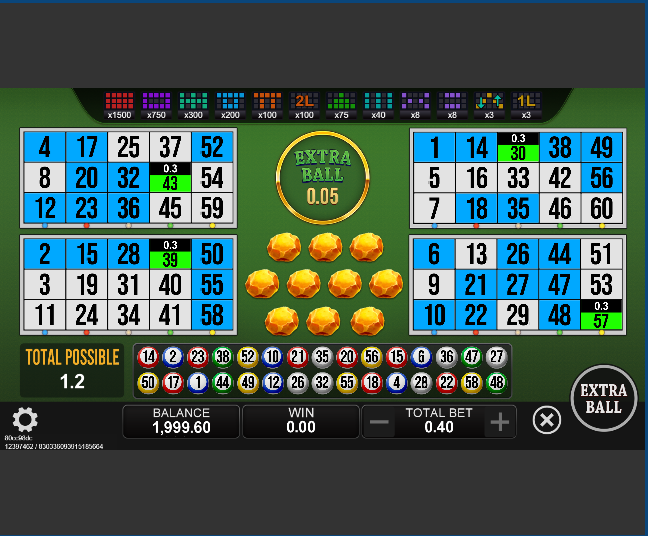
Yellow Bat's Bingo Bonanza presents itself not as a conventional reel-based slot, but as a distilled, strategy-focused bingo variant. The game deliberately sheds thematic embellishments, opting for a design that is functional and information-dense. The visual presentation is stark; a classic green baize background serves as the canvas for the entire game, reminiscent of a traditional bingo hall table or a televised lottery draw. There are no animated characters or narrative elements. The focus is placed squarely on the numbers, the patterns, and the statistical probabilities they represent. This minimalist aesthetic is a clear signal of the game’s intent: it is a product for a discerning player who prioritizes mechanical depth over visual spectacle.
The game's design is an exercise in clarity and efficiency. Every element on the screen serves a direct purpose, from the four distinct 3×5 bingo cards to the paytable prominently displayed above them. This immediate access to all critical information allows for constant strategic evaluation. The primary interface is clean, providing straightforward controls for bet adjustment and initiating the draw, ensuring that the player's attention remains on the game's core numerical progression.

Core Gameplay Loop and Mechanics
The fundamental structure of Bingo Bonanza is built around a two-stage process. The round commences with the player having four active 15-number bingo cards. A notable, yet subtle, feature is the ability to click on any of the four cards before a round begins, which instantly repopulates all cards with a new set of random numbers. This gives the player a degree of control, allowing them to cycle through sets until they find a distribution they find favorable. Once the bet is set and the game is initiated, a sequence of 30 balls is drawn from a virtual tumbler containing 60 numbered balls. As numbers are drawn, they are automatically marked off on the player's cards.
The objective is to complete one of the thirteen payable patterns shown at the top of the screen. These patterns range in complexity and value, from a simple single horizontal line (1L) offering a modest 3x multiplier, up to a full card blackout, which awards the game's top prize of 1500x the bet per card. A crucial rule governs the payouts: if a single card forms multiple winning patterns, only the highest-value pattern is awarded. For instance, completing two lines (2L) on a card, which also inherently includes a single line (1L), will only pay the 100x multiplier for the 2L pattern, not both. This hierarchy incentivizes holding out for more complex and valuable patterns rather than settling for minor wins.
The Extra Ball Decision Point
Where Bingo Bonanza truly distinguishes itself is in the phase that follows the initial 30-ball draw. Unless a significant prize has already been won, the game transitions into its Extra Ball feature. This is the strategic heart of the game, transforming it from a passive game of chance into an active exercise in risk management. The player is offered the opportunity to purchase up to 10 additional balls, one at a time, to try and complete a near-miss pattern.
The critical element here is the dynamically calculated cost of each extra ball. The price is not fixed; it is determined by the game's algorithm based on the current state of the cards and the potential prizes at stake. If the player is one number away from completing a low-value pattern, the extra ball might be relatively cheap. However, if a single number will complete the full-card pattern for a 1500x payout, the cost of that next ball will be substantially higher. This mechanic creates a compelling tension, forcing a constant cost-benefit analysis. The decision to buy another ball becomes a calculated gamble, weighing the cost of the ball against the probability of hitting the required number.
Strategic Depth in Special Ball Features
The Extra Ball phase is further enhanced by two randomly occurring special ball types that introduce significant strategic layers. Their appearance can dramatically alter the player's approach to the purchasing decision, rewarding attentiveness and sharp decision-making.
The first is the Wild Ball. When a golden ball with a “W” appears during the Extra Ball sequence, the game pauses. The player is granted agency, able to manually select any un-daubed number on their cards to mark off. The game's interface will suggest the “optimal” number—the one that would complete the highest possible prize or get closest to it—but the final choice rests with the player. This moment of direct control is powerful, allowing a knowledgeable player to override the suggestion if they have a different strategy in mind, such as completing a smaller, guaranteed win rather than chasing a larger, less certain one.
The second special feature is the Free Ball. Its appearance is purely a matter of chance, but its effect is immediately beneficial. When “FREE BALL” is displayed, the next purchased extra ball is awarded at no cost to the player. This acts as a pressure release valve during a tense chase, providing a risk-free chance to continue a promising round. The random appearance of both Wild and Free balls means that no two Extra Ball sequences are ever quite the same, demanding constant adaptation from the player.
Bingo Bonanza is a successful fusion of bingo mechanics and the risk-reward structure of a volatile slot machine. It carves out a niche for itself by appealing directly to the analytical player. Its closest market contemporary would be the Slingo series of games, yet it establishes its own identity through its four-card system and, most importantly, the strategic depth of its Extra Ball feature with its dynamic pricing and player-choice Wilds. This is not a game for those seeking immersive themes or frequent, small wins. The gameplay is methodical, and the true excitement lies in the high-stakes decisions presented in the post-draw phase.
The minimalist design, while potentially off-putting to some, is a strength for its target audience, as it eliminates distractions and keeps the focus entirely on the numbers. The potential for the Extra Ball cost to escalate rapidly is the game's primary source of volatility and should be approached with a disciplined bankroll strategy.
Ultimately, Bingo Bonanza will resonate strongly with players who enjoy games like video poker or who appreciate the mathematical underpinnings of casino games. It offers a degree of agency and strategic consideration that is rare in the broader category of number-drawing games. For the player who values calculated risk and direct mechanical engagement over passive entertainment, Bingo Bonanza is a compelling and thoughtfully constructed offering that stands apart in a crowded market.