
Archeo by SplitThePot presents a calculated departure from traditional slot design, focusing on direct player strategy within the Mines game genre. The game’s theme and minimalist atmosphere are centered on a tense archaeological dig, where each choice carries weight. Its layout consists of a multi-level grid of tiles, requiring the player to successfully select a path upwards to increase their payout. The core gameplay revolves around a persistent “cash out or continue” decision after each successful pick, putting risk management entirely in the player’s hands. Revealing a Skull tile ends the round, while uncovering special Multiplier tiles can significantly amplify winnings. A distinctive feature is its player-adjustable volatility, allowing individuals to set the game’s difficulty and risk level before starting a round. This framework makes it a compelling choice for strategists who prefer control over chance. For those who employ betting systems, the advanced auto-play offers deep customization for automated sessions.

SplitThePot's Archeo moves away from the conventional architecture of reel-based slots, presenting instead a framework centered on direct player choice and risk assessment. It belongs to the “Mines” genre of online games, where progression is not determined by random symbol combinations on paylines but by a sequence of player-made decisions. The objective is to navigate a multi-leveled grid, uncovering safe tiles to build a payout, while consciously avoiding hidden “trap” tiles. The core of the experience is the constant tension between securing a current win and risking it for a greater reward on the next level, offering a degree of control that is fundamentally different from traditional slot gameplay.
This title is constructed for the calculating player, one who finds satisfaction in managing odds and making strategic calls. Its appeal lies less in the spectacle of animated features and more in the cerebral process of weighing risk against potential return. Archeo's design strips away many of the familiar layers of modern slots to present a very direct and transparent mechanical challenge.
Core Gameplay Mechanics and Player Agency
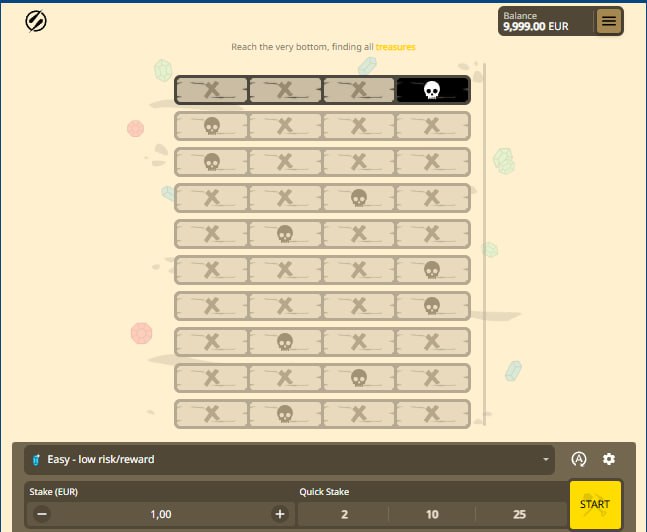
The gameplay loop in Archeo is straightforward yet holds considerable strategic depth. A round begins with the player setting a stake and selecting a difficulty level. This initial choice is paramount, as it pre-determines the risk factor for the entire round. The game presents a grid of facedown tiles, arranged in ascending rows. Each row represents a level of progression. The player selects one tile per row to reveal. A successful pick uncovers a safe tile, advances the player to the next row, and increases the cumulative payout.
At any point after a successful pick, the player is faced with a critical decision: cash out or continue. Choosing to cash out immediately banks the current accumulated winnings, ending the round. Choosing to continue means risking the entire accumulated amount for the chance to advance another level and further increase the payout. This dynamic creates a powerful sense of agency. The outcome is not passively awaited; it is actively shaped by the player's nerve and judgment. This entire process can be likened to a careful ascent up a treacherous ladder, where the player must decide at each rung whether the prize at the top is worth the risk of a fall. The round concludes either when the player chooses to cash out or when a “Skull” tile is revealed, which results in the forfeiture of the stake and all accumulated winnings for that round.
Risk Management and The Impact of Special Tiles
The difficulty setting is the primary tool for risk calibration. While the game's interface does not explicitly detail the mathematical shift, it is logical to conclude that selecting a higher difficulty populates the grid with a greater number of Skull tiles. This directly impacts the probability of failure on any given pick. A player might opt for an “Easy” setting with fewer Skulls, leading to smaller incremental payouts but a higher likelihood of reaching the upper levels. Conversely, an “Advanced” difficulty level offers substantially larger potential payouts per level but significantly increases the peril of each selection. This choice fundamentally alters the game's feel from a cautious, steady climb to a high-stakes dash.
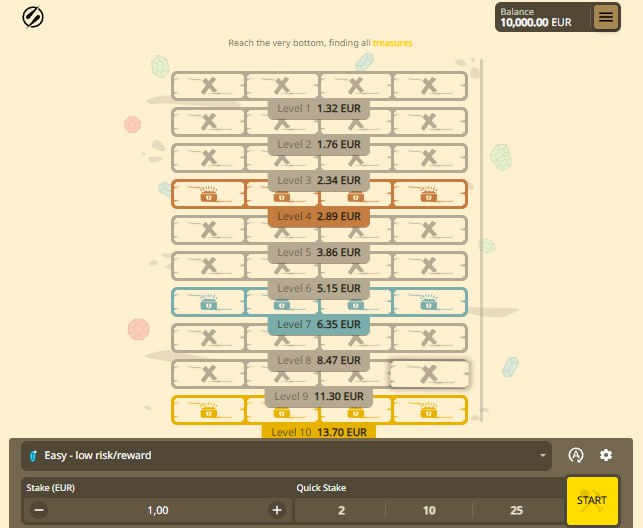
Adding a layer of variance to this calculated progression are the Multiplier tiles. These special tiles are not present on every row but appear on specific, visually highlighted levels. According to the game's paytable, revealing a tile on these rows can uncover a 2x or even an 11x multiplier. This mechanic introduces a jolt of classic slot-style unpredictability into the otherwise methodical gameplay. Uncovering a multiplier dramatically elevates the potential payout and intensifies the “cash out or continue” dilemma. A modest accumulated win can suddenly become a substantial sum, forcing a difficult re-evaluation of the player's risk tolerance for that round. The Skull tile serves as the constant, singular threat—the reset switch that brings any ambitious run to an immediate halt.
Advanced Mode: Automating Strategic Approaches
For players who engage in longer sessions or employ systematic betting strategies, Archeo provides a robust “Advanced” mode for auto-play. This feature set is considerably more detailed than the typical auto-spin function found in video slots, allowing for the implementation of complex, rules-based betting systems. It transforms the game from a purely manual, reactive experience into a system that can be programmed to execute a specific strategy over a defined number of rounds.
The customization options are granular and cater to a strategic mindset:
Number of Rounds: Players can define a specific number of game rounds, from one to a practically infinite amount, allowing the system to run for a predetermined duration.
Tile Selection: Before initiating the auto-play sequence, the player must pre-select the path of tiles to be revealed for all subsequent rounds. For example, the player might decide to always pick the leftmost tile on every level. The system will follow this path automatically in each round.
Stake Management on Win: This setting dictates how the bet amount behaves following a winning round (a round where the player successfully cashes out). The stake can be set to Reset to its original base amount, or it can be customized. The Custom option allows for a percentage-based adjustment, such as decreasing the stake by 50% or increasing it by 100% (doubling it) after a win.
Stake Management on Loss: Conversely, this setting manages the stake after a losing round (revealing a Skull). It also features a Reset option or a Custom percentage-based adjustment, enabling strategies like the Martingale (doubling the bet on a loss) or other recovery-based systems.
Max Stake: A critical safety feature, the Max Stake setting establishes a ceiling for the bet amount. If an “increase on loss” or “increase on win” strategy causes the stake to reach this predefined limit, it will not increase any further, preventing runaway bet escalation.
The interaction between the ‘On Win' and ‘On Loss' custom percentage settings can create complex betting progressions. If the full implications of these settings are not immediately clear, it is advisable to launch the Archeo demo and access the game's detailed help file by pressing the information ‘(i)' icon for a complete breakdown from the developer. This advanced suite of tools is a significant feature, elevating the game beyond a simple pastime and turning it into a platform for testing and executing betting theories, a functionality that many experienced players will find compelling.
Visual Presentation and Thematic Execution
Archeo’s aesthetic is one of deliberate minimalism. The developer, SplitThePot, has chosen a clean, uncluttered visual style that places the gameplay mechanics at the forefront. The screen is dominated by the game grid, which consists of simple, wood-textured tiles. The iconography is clear and universally understood: a treasure chest for a multiplier, a skull for a loss. There are no elaborate background scenes or distracting character animations. The color palette is muted, with soft beiges and grays, except for the colored highlights on the multiplier rows, which effectively draw the player’s attention to levels of opportunity.
The animation is functional and unobtrusive. Tiles flip over with a simple, quick effect. Payouts update instantly in the designated display area. This lack of visual noise is a conscious design choice. It ensures that the player's focus remains squarely on the grid, the payout ladder, and the critical decision-making process. For a game that is about strategy and nerve, this minimalist approach is highly effective. It respects the player's intelligence and does not attempt to mask the core mathematical nature of the game with superfluous visual flair. The user interface is equally clean, with betting controls and settings clearly labeled and positioned for easy access without detracting from the central playing field. This approach makes Archeo a suitable choice for players who want to play online without sensory overload, focusing purely on the mechanics of risk.