
Apples & Worms by Playtech offers a strategic alternative to traditional online slots, operating on a “minesweeper” mechanic that prioritizes player choice and risk management. Set in a simple orchard, the objective is to uncover valuable apples from a grid of crates while avoiding hidden worms that end the round. What sets this game apart is your ability to define the volatility by setting the grid size and worm count before each play. The gameplay is a tense exercise in probability, with a variable RTP ranging from 87.50% to 97.20%. A standout “Bank It” feature allows you to secure a portion of your winnings mid-round, adding a deep strategic layer. This title appeals to analytical players who want to test their nerve and strategy, making the free demo an ideal training ground.
 Apples & Worms
Apples & Worms Feature Summary
| Feature Name | Description | Trigger / How it Works |
|---|---|---|
| Player-Defined Grid | Choose the size of the playing field. | Select 3×3, 4×4, or 5×5 grid size before starting a round. |
| Adjustable Risk Level | Set the number of “Worm” symbols on the field. | Use the ‘+' and ‘-‘ buttons under ‘Worms' to set the number of losing symbols. |
| Pick and Click Gameplay | Reveal symbols one by one by clicking on tiles. | Click on any of the ‘?' tiles on the grid to reveal either an Apple (win) or a Worm (lose). |
| Collect Function | End the current round and secure all accumulated winnings. | Click the ‘Collect' button at any point after revealing at least one Apple. |
| Bank It Feature | Secure a portion of your current winnings while continuing the round. | In Manual mode, set an amount to bank and press ‘Bank It'. This amount is safe even if a Worm is found later. |
| Auto Mode | Pre-select a sequence of tiles to be revealed automatically. | Switch to ‘Auto' mode and click tiles in the desired order to set up an automated gameplay session. |
What is the Core Gameplay of Apples & Worms?
The core gameplay of Apples & Worms is a “minesweeper” style instant win game where you pick tiles on a grid to find winning Apple symbols while avoiding hidden Worm symbols. Each discovered Apple increases your potential payout, but finding a single Worm ends the round and forfeits any unsaved winnings.
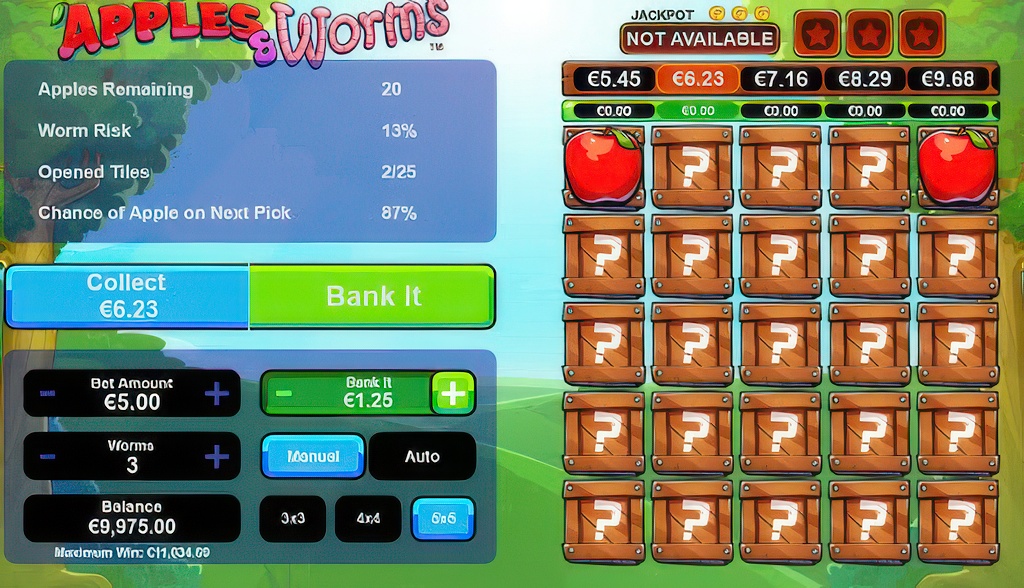
The game loop is a straightforward yet compelling test of nerve. You begin by selecting your bet amount. Then, you configure the game's difficulty and potential payout structure by choosing a grid size (3×3, 4×4, or 5×5) and the number of worms to be hidden on it. The interface transparently displays the “Worm Risk” and “Chance of Apple on Next Pick” percentages, providing you with the necessary data to make informed decisions. Once the game starts, you click on the wooden crates one by one. With each successful Apple pick, the potential prize increases, and the temptation to click just one more time grows. The entire round hinges on your decision of when to press the ‘Collect' button and walk away with your earnings.
How to Adjust Your Risk by Changing Grid Size and Worm Count?
You adjust your risk by manipulating two key variables before the start of each round: the grid size and the number of worms. A larger grid with fewer worms presents a lower-risk scenario with smaller incremental wins, while a smaller grid packed with more worms creates a high-risk, high-reward dynamic where each pick is more critical.
For example, a 5×5 grid (25 tiles) with only 3 worms offers a high chance of finding apples initially, making it suitable for a more conservative strategy. The payouts for each apple will be modest, but you can potentially uncover many of them before the risk becomes substantial. Conversely, setting up a 3×3 grid (9 tiles) with 4 worms means almost every other tile is a losing one. This configuration drastically increases the payout value of each apple found, but the probability of ending the round prematurely is much higher. The game allows for a granular level of control, enabling you to fine-tune the experience to match your preferred playstyle and risk tolerance. This game is a prime example of a Nature themed game that puts control in the player's hands.
Manual vs. Auto Mode: Which Should You Choose?
The choice between Manual and Auto mode depends on your gameplay objective; Manual mode is superior for strategic play, while Auto mode is for faster, predetermined rounds. Manual mode allows for round-by-round decision-making and access to the crucial Bank It feature, letting you react to the game's progression.
In Manual mode, you pause and think after every successful pick. This is where you can assess the escalating risk percentage and decide whether to collect, bank, or continue. Auto mode functions differently. Before the round, you pre-select a specific number of tiles and their reveal order. The game then plays out this sequence automatically. This mode is useful if you have a fixed strategy, such as “always pick the four corners and then stop,” and want to execute it quickly over multiple rounds. However, it removes the ability to use the Bank It feature and to adapt your strategy mid-round based on your accumulated winnings.
Expert's Advice (Vlad Hvalov): “Players often overlook the strategic disadvantage of Auto mode. It removes your ability to react. The real depth of Apples & Worms lies in the pause after each pick—the moment you re-evaluate the risk versus the current reward. Manual mode is where you actually play the game; Auto mode is just watching a predetermined outcome.”
The “Bank It” Feature: A Deep Dive into Strategic Gameplay
The “Bank It” feature is the game's central strategic tool, allowing you to secure a portion of your current winnings mid-round while continuing to play with the remainder. This mechanic fundamentally changes the risk calculation, providing a safety net that separates this game from more primitive minesweeper formats.
Unlike a simple “all or nothing” system, Bank It introduces a nuanced layer of bankroll management directly into the gameplay. By banking a part of your win, you ensure you walk away with something, even if the very next pick reveals a worm. This makes it possible to pursue a more aggressive strategy for a larger payout while still incrementally building your balance. The decision of how much to bank and when adds a compelling element of skill and foresight to what could otherwise be a simple game of luck. This smart mechanic puts it in the category of engaging Money games.
How Does the Bank It Mechanic Work?
The Bank It mechanic allows you to divert a player-selected amount from the current “at-risk” winnings into a secure, banked balance. This action is only available in Manual mode after you've found at least one Apple.
To use it, you adjust the amount in the “Bank It” field and confirm your choice. The prize ladder at the top of the screen will immediately update, showing lower potential winnings for subsequent apple picks, as the total pot has been reduced by the amount you secured. The banked amount is added to a green “saved win” cell. This banked money is yours to keep for the round, regardless of the outcome. The remaining winnings continue to be at risk. This process can be repeated after every subsequent apple is found, allowing for a dynamic approach to risk management throughout a single successful round.
When is the Best Time to Use the Bank It Option?
The best time to use the Bank It option is when the accumulated winnings reach a significant amount relative to your base bet, but the calculated “Worm Risk” is becoming uncomfortably high. It serves as a perfect middle-ground between the aggressive “keep picking” and the conservative “collect now” options.
Consider a scenario where your initial bet was €5, and you have accumulated €50 in winnings. The risk of finding a worm on the next pick has climbed to 30%. Cashing out seems safe, but the next apple could push the prize to €75. This is the ideal moment for the Bank It feature. You could, for instance, bank €25 (a 5x return on your bet) and continue playing with the remaining €25. This way, you have guaranteed a profit for the round while still giving yourself a chance to win more. It's a tool for locking in profit while still pursuing a larger prize.
What is the Apples & Worms RTP and Volatility?
The Apples & Worms game has a theoretical Return to Player (RTP) that ranges from 87.50% to 97.20%. The game's volatility is player-defined, meaning your strategic choices directly determine the risk and reward profile of each round.
Unlike traditional slots with a fixed RTP and volatility, this game's parameters are fluid. The wide RTP range is a direct consequence of the game's customizable nature. Your choices—the grid size, the number of worms, and how many apples you collect before cashing out—all influence the effective RTP you experience over a game session. Similarly, volatility isn't a static rating assigned by the developer; it's a dynamic factor you control.
Understanding the RTP Range in Apples & Worms
The RTP is a range because it is calculated based on optimal play over billions of simulated rounds across all possible game configurations. A player employing a mathematically sound, low-risk strategy of collecting after just a few apples on a large grid might experience an RTP closer to the 97.20% mark.
Conversely, a player making consistently high-risk choices, such as trying to clear a small grid with many worms, will push their effective RTP towards the lower end of the spectrum. The game's transparency in showing the exact probability of finding an apple on the next pick is a key piece of information. Players who use this data to make decisions are more likely to achieve a return rate at the higher end of the published range.
How Your Choices Define the Volatility
You directly define the volatility by setting the number of worms relative to the number of tiles. This is the clearest example of player agency in the game's design.
- Low Volatility Setup: Choose the large 5×5 grid and a small number of worms (e.g., 1-3). This setup results in frequent, small wins. You will find apples often, but the payout for each one will be minimal. The risk of losing is low, but the potential for a large single-round win is also diminished.
- High Volatility Setup: Choose the small 3×3 grid and a high number of worms (e.g., 4-6). This configuration leads to infrequent but significant wins. Most rounds will end quickly with a worm, but surviving just two or three picks can result in a payout many times your stake. This is a high-risk, high-reward approach.
Visuals and Atmosphere: A Different Kind of Orchard
The visual presentation of Apples & Worms is clean, functional, and user-interface-driven, creating a focused and analytical atmosphere. It avoids the flashy animations and thematic immersion of video slots, instead opting for a design that prioritizes clarity of information, which is a hallmark of many Classic style games.
The game is set against a simple, cartoonish backdrop of an orchard. The main focus is the grid of crates and the data panel on the left. All the crucial information—Apples Remaining, Worm Risk, Opened Tiles, and Chance of Apple—is displayed clearly, reinforcing that this is a game of numbers and probabilities. The symbols themselves are simple: a juicy red apple representing a win and a cartoon worm for a loss. The audio is likewise minimalist, with simple clicks and confirmation sounds that don't distract from the decision-making process. The entire design ethos serves the gameplay, ensuring the player is focused on strategy, not spectacle. The simple depiction of Fruit and an Animal character keeps the theme light.
Secrets of the Orchard: Deeper Insights into Apples & Worms
Beneath its simple exterior, Apples & Worms holds a few interesting design principles that set it apart from typical casino games.
- A Probability Puzzle: The game's core math is more akin to a classic probability puzzle, like the Monty Hall problem, than the opaque RNG of a slot machine. The displayed percentages aren't an estimate; they are the literal, real-time calculation of your odds. With 10 tiles left and 2 worms, your risk is exactly 20%. This transparency is rare and appeals to players who want to make decisions based on clear data.
- Built-in Bankroll Management: The Bank It feature is a clever implementation of a risk-management strategy. Expert players often talk about “taking profit off the table.” Playtech has turned this abstract concept into a concrete gameplay button, encouraging smarter playing habits directly within the game's rules.
- Catering to the Analyst: The UI design, prioritizing statistics over elaborate graphics, is a deliberate choice to attract a specific type of player. The game is less for the pure thrill-seeker and more for the analytical player who enjoys calculating odds and managing risk. It acknowledges that for some, the thrill comes from making the right data-driven decision.
Apples & Worms Compared to Other Casino Games
Apples & Worms occupies a unique space in the casino game landscape, sharing characteristics with several genres but belonging to none of them perfectly. Its gameplay offers a level of control and strategic depth that distinguishes it from the majority of chance-based titles.
Apples & Worms vs. Traditional Slots
The primary difference is the concept of player agency. In a traditional slot machine, the player's only decision is the bet size and when to press “spin.” The outcome is then determined entirely by a Random Number Generator. In Apples & Worms, the player is constantly making meaningful choices that directly impact the outcome and volatility of the round: setting the risk level, choosing which tile to pick, and, most importantly, deciding when to stop. While RNG still determines the initial placement of worms, the player navigates that predetermined field based on skill and nerve.
Alternatives to Apples & Worms: Exploring Other Minesweeper Games
Apples & Worms belongs to the growing subgenre of “Mines” or “Minesweeper” casino games. While Playtech has its own unique take with the “Bank It” feature, other providers have explored similar territory. Games like Mines by Spribe or Evoplay's Minesweeper offer a similar core loop of uncovering safe symbols while avoiding hidden mines. However, few have integrated a mechanic as strategic as the “Bank It” option, which gives Apples & Worms a distinct analytical edge over its competitors that often rely on a simpler “cash out or keep going” binary choice.
Expert's Advice (Vlad Hvalov): “Don't treat this game like a slot. Your intuition from playing slots won't help you here. Your best tools are the probability stats on the screen and a disciplined approach to collecting or banking. Decide on a goal for each round—for instance, a 2x return—and stick to it. Greed is punished more directly here than in almost any other game.”
Can You Develop a Winning Strategy for the Apples & Worms Demo?
Yes, you can develop and test various strategies in the Apples & Worms demo, though no strategy can guarantee a win due to the element of chance. The demo is the perfect environment for understanding how different risk setups and collection tactics affect your results without financial risk.
The core of any strategy in this game revolves around risk management and setting clear goals for each round. The demo allows you to experiment with this freely. You can test a high-volatility “hit and run” approach or a low-volatility “grind” strategy and see which one aligns better with your temperament and goals. The most valuable lesson the demo teaches is discipline—learning to be content with a modest win rather than always pushing for one more tile.
Low-Risk vs. High-Risk Approaches
Your strategy is defined by your initial setup. A low-risk strategy involves using the 5×5 grid with the minimum number of worms. The goal here is to accumulate small, consistent wins. A common tactic is to uncover 3-5 apples and then collect, repeating the process. The wins are small, but the frequency of winning rounds is higher.
A high-risk strategy involves the 3×3 grid with a high number of worms. Here, the goal is to land a large payout in a short number of picks. Many rounds will result in an immediate loss, but a round where you successfully find 2 or 3 apples can yield a substantial return. This approach requires a larger bankroll to withstand the frequent losses between big wins.
The Importance of the ‘Collect' Button
Regardless of your strategy, the ‘Collect' button is the most important one in the game. The fundamental skill in Apples & Worms is not picking the right tiles but knowing when to stop picking. A successful session is not defined by how many apples you find, but by how many times you press ‘Collect' before finding a worm. Every profitable round ends with a conscious decision to lock in the win. The demo is an excellent tool for training this discipline, teaching you to walk away from a round as a winner.
In conclusion, Apples & Worms is a refreshing departure from standard slot formats. It's a game for the thinking player, one who enjoys having a degree of control over the risk and reward. Its customizable volatility and the brilliant “Bank It” feature provide layers of strategic depth. The clean, data-focused presentation might not appeal to players seeking cinematic experiences, but for those who appreciate probability and tactical decision-making, it is a well-designed and engaging title. I recommend trying the Apples & Worms demo to fully appreciate its unique mechanics; it offers a level of interaction and control that is rare to find.
FAQ
No, Apples & Worms is not a traditional slot game with reels and paylines. It is an instant win “minesweeper” style casino game where players pick tiles on a grid to reveal prizes and avoid losing symbols.
There is no single “best” strategy, as it depends on your risk tolerance. A common low-risk approach is to use a large grid (5×5) with few worms and collect after 3-4 apples. A high-risk strategy involves a small grid (3×3) with many worms, aiming for a big payout in just 1-2 picks. The key is to use the “Bank It” feature to manage risk effectively.
The “Bank It” feature lets you secure a portion of your current winnings during a round. The banked amount is safe and will be paid out even if you find a worm later. The remaining, unbanked winnings are still at risk as you continue picking tiles.
Yes, you have direct control over the game's volatility. By choosing the grid size (3×3, 4×4, or 5×5) and the number of worms hidden on it, you determine the risk and reward structure for each round you play.
The theoretical Return to Player (RTP) for Apples & Worms is a range, from a minimum of 87.50% to a maximum of 97.20%. The actual RTP you experience depends on your game settings and strategy.
If you successfully uncover all the Apple symbols on the grid without hitting a Worm, you win the maximum possible prize for that round's configuration. The game will automatically collect your winnings and end the round.
No, Apples & Worms does not have traditional slot features like free spins, wild symbols, or scatter-triggered bonus rounds. Its main special feature is the “Bank It” mechanic.
The free demo version of the Apples & Worms game is available to play directly on the Respinix.com website, allowing you to test strategies and learn the mechanics without any risk.